How wars ended
The Congress of Vienna
After more than twenty years of war, the European powers negotiated a new order in Vienna. What came out of it held longer than anything before it
Key points at a glance
- The Congress of Vienna met from autumn 1814 to June 1815 and reordered Europe after the wars against revolutionary and Napoleonic France.
- Decisions lay with five great powers: Austria under Metternich, Prussia, Russia, Britain and, from January 1815, defeated France as well.
- It agreed new borders, the return of old dynasties, a balance of power and the German Confederation as a union of sovereign states.
- Between the great powers almost forty years without a major war followed; at home the order went hand in hand with censorship and repression.
In numbers
9
months of talks
October 1814 to June 1815
5
leading powers
plus dozens of smaller states
39
states in the German Confederation
roughly; the number changed later
Represented by
- Austria
- State Chancellor Metternich
- Prussia
- Foreign Minister Hardenberg
- Russia
- Tsar Alexander I
- Britain
- Foreign Secretary Castlereagh
- France
- Foreign Minister Talleyrand
Outcome in Vienna
- Austria
- Tyrol, Salzburg, Galicia, Milan and Venetia, gave up the Netherlands
- Prussia
- Two fifths of Saxony, Posen, Danzig, Westphalia and lands on the Rhine
- Russia
- Kingdom of Poland in personal union, known as Congress Poland
- Britain
- Kept Heligoland, Malta, the Cape Colony and Ceylon
- France
- Borders of 1792, part of the negotiations from January 1815
Arrival in September 1814
Representatives of some 200 states, lordships, corporations and cities arrive in Vienna.
Decisions in a small circle
The ministers of Austria, Prussia, Russia and Britain claim the sole right to decide on territory.
France joins
Talleyrand at first has only observer status. From January 1815 France takes part in the talks.
Work in committees
Separate committees deal with the German and the European question, from navigation on the Rhine to the slave trade.
Dispute over Saxony and Poland
Around the turn of 1814 to 1815 a new war looms. Both sides back down, and Prussia receives two fifths of Saxony.
A single plenary
All participants meet only once, to sign the Final Act of 9 June 1815.
- Period
- October 1814 to June 1815
- Place
- Vienna
- Parties
- Austria, Prussia, Russia, Great Britain and France, along with envoys from numerous smaller states
- Outcome
- A reordering of the continent and the German Confederation, set down in the Final Act of 9 June 1815
- Author
- Johannes Max Harms
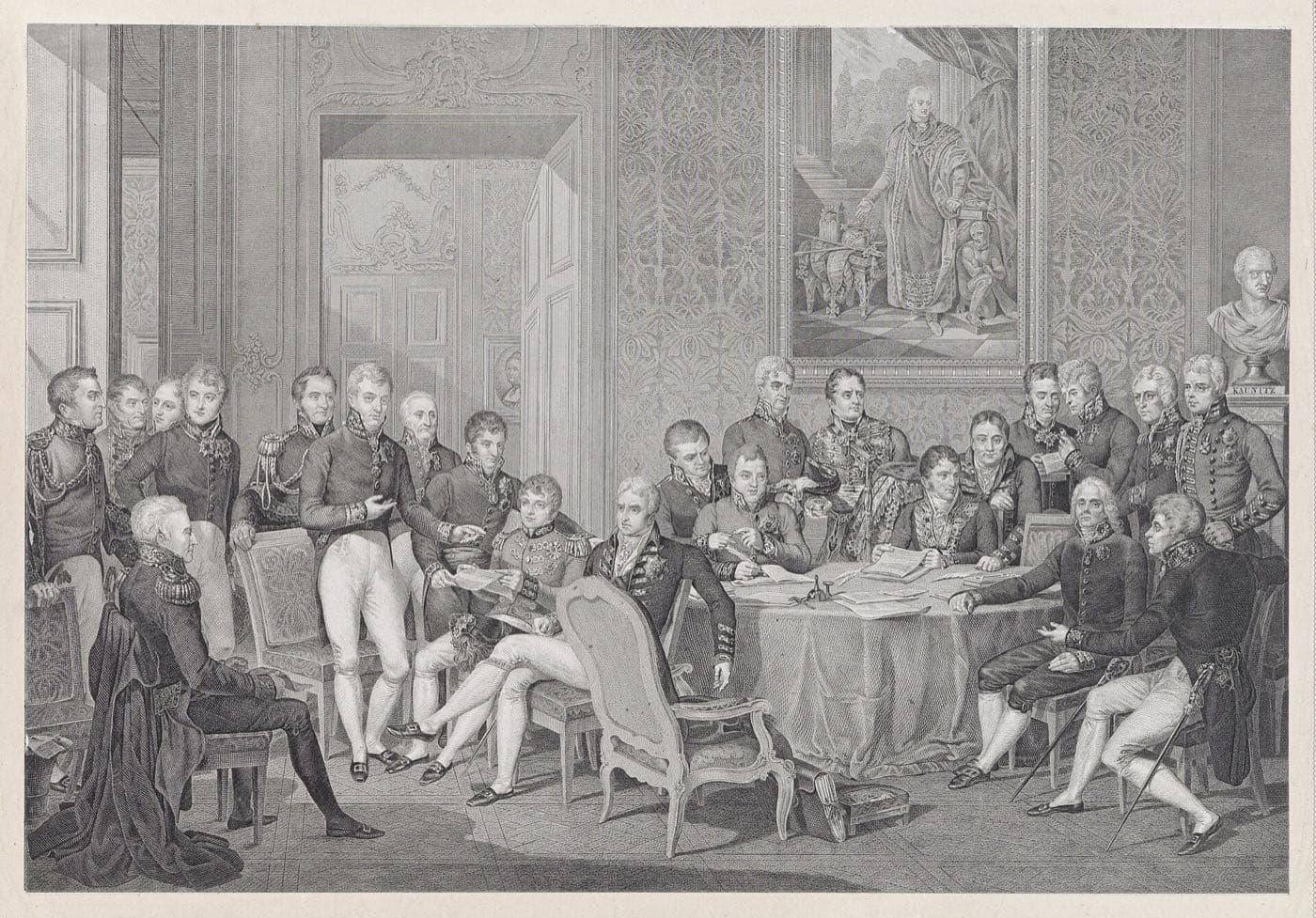
What was the Congress of Vienna?
From October 1814 to June 1815, statesmen and diplomats gathered in Vienna to reorder a continent that revolution and war had shaken for two decades. The gathering was led by the Austrian state chancellor Clemens von Metternich.
The congress was not a peace treaty in the narrow sense. The First Peace of Paris of 30 May 1814 had already ended the war and expressly referred the open questions to a later gathering. So Vienna was not about whether there would be peace but on what terms.
Talks ran for nine months in shifting groups, often away from the official sessions. What came of it was the Final Act of 9 June 1815, a bundle of agreements rather than a single treaty.
Who negotiated, and to what end?
The tone was set by the four powers that had defeated Napoleon: Austria, Prussia, Russia and Great Britain. France sat at the table as the loser and regained weight as the talks went on. Envoys from numerous smaller states competed for their place in the new order.
The stated aim was to restore conditions as they had stood before the French Revolution. The second, unstated aim was more practical: prevent future revolutions and make sure no single power could dominate the continent again.
Together those two aims explain the peculiar character of this settlement. Outwardly it was built for balance; inwardly, for standstill.
What was agreed?
Borders were redrawn, territories exchanged, dynasties restored. For the German-speaking lands the most consequential decision was the German Confederation: an association of sovereign states in place of the dissolved old empire, set down in the Federal Act that became part of the Final Act of 9 June 1815.
Behind it stood a principle that reached beyond the individual decisions: a balance of power in which no state should be strong enough to overwhelm the others. That thinking shaped European diplomacy for the rest of the century.
In September 1815 it was joined by the Holy Alliance between Russia, Austria and Prussia. It presented itself as a community of values and worked in practice as an alliance against any movement that unsettled the new order.
How long did the peace hold?
Decades followed without a major war between European states. The nineteenth century has for that reason been called the most peaceful period in European history. Measured against the twenty years before it, that is the most remarkable finding about these negotiations.
The settlement survived a hard test along the way. Napoleon returned to France in the middle of the talks; only his defeat at Waterloo on 18 June 1815 closed that episode. What Vienna had agreed was then confirmed rather than renegotiated.
Inside those states it looked different. The Carlsbad Decrees of September 1819 brought censorship and surveillance of the universities, along with a central investigating commission in Mainz. Pressure built for decades until it broke out in the revolutions of 1848. The congress made peace between states, not freedom within them.
What is there to learn from it?
That peace can be negotiated, even after twenty years of war and between opponents who were fighting each other until recently. And that it takes time: the parties sat together for nine months, and the real work began once the weapons had long fallen silent.
The limit is just as clear. A peace that only secures the absence of war while passing over what people inside those states want stays brittle. Peace research calls that negative peace, as against positive peace, where the conditions violence grows out of are absent too.
Two things follow for today. First: peace has to be made, and that takes time. Second: a ceasefire is a beginning, not a result. Both hold between states as much as between neighbours.
Which borders were redrawn?
The fiercest dispute was over Saxony and Poland. Prussia demanded the whole Kingdom of Saxony, which had fought on Napoleon’s side, while Russia wanted to extend its rule over Polish territory. Together, the two demands would have undone the balance everyone was aiming for. For a short time Russia and Prussia therefore stood against Austria, France and Britain, and around the turn of 1814 to 1815 the quarrel threatened to become a new war.
Both sides stepped back. Prussia received two fifths of Saxony, together with Posen, Danzig, the lands on the left bank of the Rhine and Westphalia, and afterwards covered some 280,000 square kilometres with about 10.3 million inhabitants. Russia gained the Kingdom of Poland in personal union, known as Congress Poland. Austria gave up its former Netherlands and received Tyrol, Salzburg, Galicia, Milan and Venetia, among others. Britain kept Heligoland, Malta, the Cape Colony and Ceylon.
France was held to its borders of 1792. Behind the new order lay an idea of security: the Netherlands, Piedmont-Sardinia, Switzerland and a Prussia reaching to the Rhine were to form a protective wall along France’s eastern border. The German Confederation belonged to the same system. The borders drawn in Vienna largely remained in place until the middle of the nineteenth century, and the hope for an independent Polish state was not fulfilled.
How did the diplomats work in Vienna?
In September 1814 representatives of some 200 states, lordships, corporations and cities arrived in Vienna. Yet decisions were taken by a small circle. The ministers of Austria, Prussia, Russia and Britain claimed the sole right to decide on territory. France, represented by its foreign minister Talleyrand, at first had only observer status and was brought into the negotiations only in January 1815.
The work was done in committees that dealt separately with the German and the European questions. The agenda ranged from shipping on the Rhine to ending the slave trade. The congress met as a plenary of all participants only once, at the very end, to sign the Final Act. Agreement therefore grew out of committee sessions and private talks, not out of one great assembly.
Alongside the talks, Vienna offered balls, concerts and hunts, and some festivities drew up to 12,000 guests. This gave rise to the saying “The congress dances, but it does not move forward”. Historians see it differently: above all, the delegates met for a great many working sessions. Vienna also produced a habit that outlasted the congress. Between 1818 and 1822 the powers met almost every year for conferences.
What follows from it
A peace that only silences the weapons is stable and still unfinished. The rest begins afterwards.
Sources
- German Federal Agency for Civic Education: The Congress of Vienna and the Restoration period (in German)
- German Federal Agency for Civic Education: Congress of Vienna, Aus Politik und Zeitgeschichte 22 to 24/2015 (in German)
- Deutsches Historisches Museum, LeMO: Congress of Vienna, the reordering of Europe 1814/15
- City of Vienna, Wien Geschichte Wiki: Congress of Vienna (1814/1815)
- Haus der Bayerischen Geschichte: Congress of Vienna, 18 September 1814 to 9 June 1815
- Planet Wissen (WDR, SWR, BR): The Congress of Vienna
How it unfolded
- 23 April 1814An armistice ends the fighting. Napoleon has abdicated and the war is decided, but the order that follows is open.
- 30 May 1814The First Peace of Paris is signed. It settles relations with France and refers everything else to a congress.
- October 1814The congress opens under the Austrian state chancellor Clemens von Metternich.
- 9 June 1815The Final Act is signed. It contains the Federal Act and with it the German Confederation, an association of sovereign states.
- 18 June 1815Napoleon is defeated at Waterloo. The Second Peace of Paris follows and confirms what was agreed in Vienna.
- September 1815Russia, Austria and Prussia found the Holy Alliance. The peace settlement becomes an alliance against change.
- September 1819The Carlsbad Decrees bring censorship and surveillance of the universities. Peace abroad is paid for with repression at home.
More in this series
- The Peace of Westphalia1644 to 1648Envoys negotiated in two cities for five years while the war went on. What came out of it is still treated as a model for talks between enemies
- The Treaty of VersaillesJanuary 1919 to January 1920On 28 June 1919 the parties signed a treaty in the Hall of Mirrors at Versailles that only one side had drafted. How long it could hold was decided by that
Frequently asked questions
When did the Congress of Vienna take place?
The delegations arrived in Vienna in September 1814, and on 18 September the ministers of the four victorious powers began their talks. Negotiations ran from October 1814 to June 1815 and ended with the signing of the Final Act. A few days later, on 18 June 1815, the military decision against Napoleon came at Waterloo.
What were the principles of the Congress of Vienna?
Five principles are usually named. Restoration meant bringing back the old political order, legitimacy the return of ousted ruling houses such as the Bourbons in France. Solidarity committed the monarchs to act together against revolutionary movements. Compensation settled competing territorial claims, and a balance of power was meant to prevent any one power from dominating the others.
What happened to Napoleon during the congress?
Napoleon had abdicated in 1814 and been exiled to the island of Elba. On 26 February 1815 he left Elba and on 1 March landed near Antibes in France, which led to renewed fighting. The negotiations in Vienna nevertheless carried on. Only the Battle of Waterloo on 18 June 1815 brought the final victory over him.
What happened to Germany after the Congress of Vienna?
The congress did not create a German nation state. The dissolved Old Empire was replaced by the German Confederation, a federation of sovereign states whose only common body was a permanent Federal Assembly. The first years are regarded as open, both for constitutions in the individual states and for greater national unity. The Confederation lasted until 1866.
What role did France play at the congress?
France sat at the table as a defeated power and took full part in the negotiations from January 1815. Its rank as a great power was left untouched because it was needed for the balance. Historians count it as an achievement of this order that it avoided a victors’ peace that would have humiliated the defeated side and shut it out for good.
From history to a mission of your own
Every one of these treaties was the work of people who thought it could be done. The same stance is what it takes on a small scale: in a neighbourhood, a school, a club.
Find your peace mission