How wars ended
The Treaty of Versailles
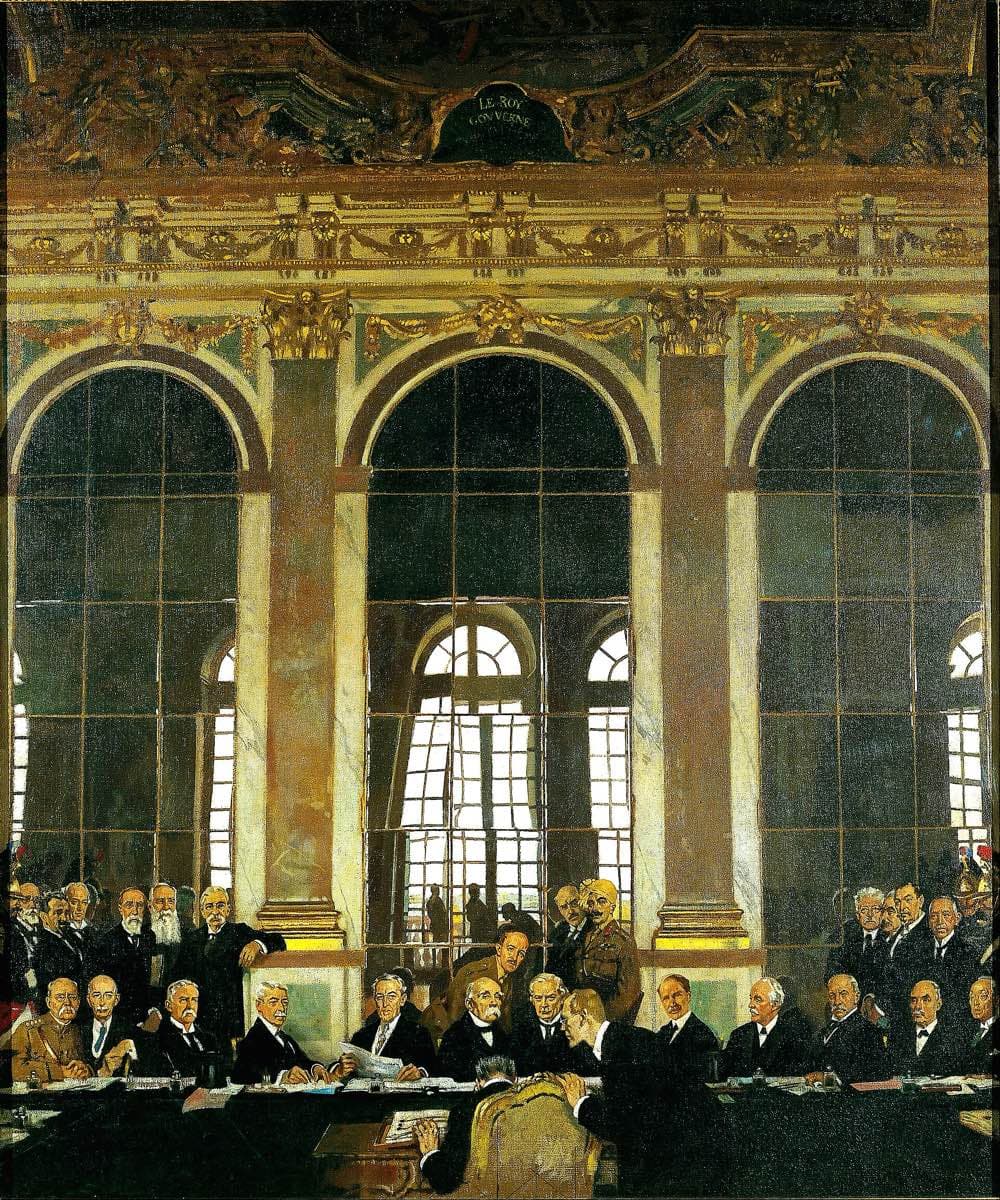
On 28 June 1919 the parties signed a treaty in the Hall of Mirrors at Versailles that only one side had drafted. How long it could hold was decided by that
Key points at a glance
- The Treaty of Versailles, signed on 28 June 1919 and in force from 10 January 1920, ended the First World War between the German Reich and the Allies.
- The victorious powers negotiated it in Paris; the German delegation received the finished text and could raise objections only in writing.
- Germany lost a seventh of its territory with a tenth of its population and all its colonies, had to disarm and pay reparations.
- The treaty also created the League of Nations, remained fiercely contested in the Weimar Republic and was one of five Paris suburban treaties.
In numbers
440
articles
in fifteen parts, plus annexes
27
states at the table
the German Empire was not one of them
100,000
troops permitted
ceiling for the army, no air force
What it created
- It ended the state of war that the armistice of 11 November 1918 had left open.
- Part I contains the Covenant of the League of Nations, the first permanent body meant to negotiate conflicts between states.
- Part XIII founded the International Labour Organization.
- It stayed open to change: Locarno in 1925, League of Nations membership in 1926, reparations adjusted several times.
Where it reached its limits
- The German Empire was not at the table and could raise objections only in writing.
- At home it stayed contested and became a rallying point for the republic’s opponents.
- The League of Nations failed for lack of means.
- Twenty years after it entered into force the Second World War began. Historians draw no straight line from one to the other.
Signed
- Versailles
- 28 June 1919
- Saint-Germain-en-Laye
- 10 September 1919
- Neuilly-sur-Seine
- 27 November 1919
- Trianon
- 4 June 1920
- Sèvres
- 10 August 1920
With
- Versailles
- German Reich
- Saint-Germain-en-Laye
- Austria
- Neuilly-sur-Seine
- Bulgaria
- Trianon
- Hungary
- Sèvres
- Ottoman Empire
Key point
- Versailles
- Territorial losses, all colonies, reparations
- Saint-Germain-en-Laye
- Recognition of Czechoslovakia and the Kingdom of Serbs, Croats and Slovenes
- Neuilly-sur-Seine
- Border areas ceded, 2.25 billion gold francs
- Trianon
- Lost 67% of its territory and 58% of its population
- Sèvres
- Large territories ceded, foreign military and financial control
- Period
- January 1919 to January 1920
- Place
- Paris and Versailles
- Parties
- The German Empire and 27 allied and associated powers, with France, Britain, the United States and Italy setting the terms
- Outcome
- A treaty of 440 articles, signed 28 June 1919, in force from 10 January 1920, with the Covenant of the League of Nations as its Part I
- Author
- Johannes Max Harms
What was the Treaty of Versailles?
The Treaty of Versailles is the peace treaty that formally ended the First World War between the German Empire and the allied powers. It was signed on 28 June 1919 in the Hall of Mirrors at the Palace of Versailles and entered into force on 10 January 1920.
The armistice of 11 November 1918 had stopped the fighting without ending the state of war. The treaty closed exactly that gap: it settled borders, compensation, armament and responsibility, and with the League of Nations it created an institution meant to prevent future wars.
The text runs to 440 articles in fifteen parts. Part I contains the Covenant of the League of Nations, Part XIII founds the International Labour Organization. The treaty is therefore not only a reckoning but also the beginning of modern international organisation.
Who negotiated, and who did not?
From 18 January 1919, representatives of 27 allied and associated states met in Paris. Four set the direction: France, Britain, the United States and Italy, and in substance mainly the first three.
Their aims were far apart. France sought lasting security against a neighbour on whose soil the war had not been fought. Britain wanted a balance that would get trade moving again. The American president Woodrow Wilson had put forward fourteen points whose core was self-determination and an organisation to keep the peace.
The German Empire was not at the table. Its delegation received the finished text on 7 May 1919 and could raise objections only in writing. That procedural decision produced the word about a dictated peace, which shaped the German debate about the treaty from the start.
What was agreed?
The German Empire ceded roughly a seventh of its territory: Alsace-Lorraine to France, large parts of West Prussia and the province of Posen to the restored Poland, smaller areas to Belgium, Denmark and Czechoslovakia. Danzig became a free city under the protection of the League of Nations, the Saar was placed under its administration for fifteen years. The colonies went to the victorious powers as mandates.
Militarily the army was capped at 100,000 men, conscription abolished, heavy artillery, tanks, an air force and submarines prohibited, and the Rhineland demilitarised and occupied for fifteen years.
Article 231 assigned responsibility for the damage of the war to the German Empire and its allies and grounded the obligation to pay reparations. The amount was left open at first; the London schedule of payments of May 1921 set it at 132 billion gold marks, a figure revised several times during the twenties.
How long did the peace hold?
Twenty years lay between its entry into force in January 1920 and the outbreak of the Second World War in September 1939. None of the historic settlements this series covers carried for a shorter time.
There were years in which it looked otherwise. The Locarno treaties of 1925 settled the western border by agreement, in 1926 the German Empire joined the League of Nations, and reparations were repeatedly adjusted to economic conditions. That phase shows the treaty itself was open to change.
At the same time it remained permanently contested at home and became a reference point for the opponents of the republic. Historians still disagree about how much weight the treaty carries on the road to the next war and how much belongs to the world economic crisis, to domestic conditions and to the decisions of the thirties. Research does not draw a straight line from 1919 to 1939.
What is there to learn from it?
The most striking difference from the Congress of Vienna a century earlier lies not in the content but in the procedure. In Vienna the defeated power sat at the table and regained weight during the talks. In Paris it was negotiated about. One peace held for decades, the other for twenty years.
No rule follows from that, but a question does. Whoever ends a dispute decides twice: on the outcome, and on who was allowed to take part. The second decides whether the first still carries once the signing is over.
The other half of the same treaty is worth noting. The League of Nations was the first standing institution meant to negotiate conflicts between states rather than fight them out. It failed for want of means, yet the United Nations of 1945 build recognisably on the idea. Even failed institutions leave tools behind.
Why did the German government sign?
The terms met broad rejection in Germany, from the far right to the Social Democrats. Above all because of the article on responsibility for the war, the treaty was seen as a dictate and a peace of shame. Minister President Philipp Scheidemann had declared that the hand of whoever signed it should wither. So as not to bear responsibility for the signature, his cabinet resigned as a whole in June 1919.
The Allies left little room. After handing over the final version they set a deadline for acceptance of first five, then seven days and threatened intervention. Leading German military figures considered resistance hopeless. Under this pressure the National Assembly in Weimar approved the treaty by 237 votes to 138. In the judgement of the Deutsches Historisches Museum there was no politically defensible alternative to signing.
On 28 June 1919 the new foreign minister Hermann Müller and transport minister Johannes Bell signed in the Hall of Mirrors. The democratic parties paid a high price for this signature. Opponents of the republic accused them of betraying German interests and equated the treaty with the republic itself. Together with the stab-in-the-back myth, it served in the following years as material for agitation against the Weimar Republic and against other countries.
How long were the reparations paid?
The treaty fixed the obligation to pay reparations, but not the amount. The London Schedule of Payments of 1921 was followed by several revisions. The Dawes Plan of 1924 eased the confrontation and opened new economic prospects. The Young Plan of 1929 set the total at 112 billion gold marks, to be paid off by 1988. A referendum against the Young Plan, pursued by the NSDAP, the DNVP and the Stahlhelm, failed.
The world economic crisis ended the payments. At the Lausanne Conference in July 1932 the Allies gave up further claims; all that was agreed was a final payment of three billion Reichsmarks, which was never made. According to the Deutsches Historisches Museum, the German Reich had actually paid 25 billion gold marks between 1919 and 1932, plus deliveries in kind. Other calculations reach different totals depending on how they are valued.
That did not settle the matter entirely. To service the reparations the Reich had taken out foreign loans, among them the Dawes loan of 1924 and the Young loan of 1930. The Federal Republic dealt with them in the London Debt Agreement of 1953. Interest arrears for the years 1945 to 1952 were deferred in that agreement until a reunification and serviced from 1990. The Federal Republic made the last of these interest payments in 2010.
What follows from it
A peace that one side merely signs is a document. It carries only once both sides find something of their own in it.
Sources
- German Federal Agency for Civic Education: 100 years ago, the Treaty of Versailles (in German)
- German Historical Museum, LeMO: The Treaty of Versailles (in German)
- Deutsches Historisches Museum, LeMO: Treaty of Versailles (Weimar Republic, foreign policy)
- Deutsches Historisches Museum, LeMO: Reparations
- Deutsches Historisches Museum, LeMO: Lausanne Conference
- Historisches Lexikon Bayerns: Treaty of Versailles, 1919/20
- Federal Agency for Civic Education: The Treaty of Versailles, a peace that was no peace, Aus Politik und Zeitgeschichte 15/2019
- Federal Agency for Civic Education: Paris suburban treaties, political lexicon
- Deutsches Historisches Museum: Peace settlements, exhibition The First World War
- Norddeutscher Rundfunk: Treaty of Versailles, signing, content and consequences
- Research Services of the German Bundestag: Financial obligations of the Federal Republic of Germany arising from the Treaty of Versailles (WD 1 088/08)
How it unfolded
- 11 November 1918The armistice of Compiègne ends the fighting. In law the war is not over but suspended.
- 18 January 1919The peace conference opens in Paris. Twenty-seven states negotiate; the defeated side is not invited.
- 7 May 1919The German delegation receives the finished text. There is no negotiation over it, objections are to be submitted in writing.
- 28 June 1919Signature in the Hall of Mirrors at Versailles, five years to the day after the shots at Sarajevo.
- 9 July 1919The Weimar National Assembly votes to ratify, after a debate that splits the young republic.
- 10 January 1920The treaty enters into force. The same day the League of Nations begins work, the first standing organisation for securing peace.
- May 1921The London schedule of payments puts reparations at 132 billion gold marks. The figure is revised several times in the years that follow.
- September 1926The German Empire joins the League of Nations. The path there ran through the Locarno treaties a year earlier.
More in this series
- The Congress of ViennaOctober 1814 to June 1815After more than twenty years of war, the European powers negotiated a new order in Vienna. What came out of it held longer than anything before it
- The Treaty of Brest-LitovskDecember 1917 to November 1918In March 1918 the war on the eastern front ended with a treaty dictated by one side. Eight months later it was void
Frequently asked questions
What does Article 231 of the treaty say?
Article 231 names Germany and its allies as responsible for all the loss and damage the Allies suffered through the war. It was meant above all to secure the obligation to pay reparations in international law. In Germany it was understood as an assignment of sole guilt and felt to be a moral degradation. An Allied covering note replying to German objections then stated the guilt explicitly.
What was the stab-in-the-back myth?
The stab-in-the-back myth claimed that Germany had been undefeated in the field and had not lost the war militarily. It denied the historical facts, because the army commanders Hindenburg and Ludendorff knew that Germany was beaten. Together with the peace treaty, the myth was used in the Weimar Republic for agitation against the republic.
Why was the treaty signed in the Hall of Mirrors?
In the Hall of Mirrors at Versailles the German Empire had been proclaimed on 18 January 1871, after the victory over France. In France this was seen as a disgrace. Georges Clemenceau, chairman of the peace conference, pursued the aims of revenge, retribution and security, according to an analysis by the Federal Agency for Civic Education. For the signing he summoned five French soldiers disfigured in the war to the hall.
What did Germany lose through the treaty?
The German Reich lost a seventh of its territory, ten per cent of its population and all its colonies. Alsace-Lorraine went to France, Posen and West Prussia to Poland. The army was limited to 100,000 professional soldiers and the navy to 15,000 men, and air forces were banned. On top of this came reparations, partly to be delivered in kind.
Which treaties make up the Paris suburban treaties?
The Paris suburban treaties are five peace treaties that ended the First World War. Besides the treaty with Germany they include the treaties of Saint-Germain-en-Laye with Austria, Neuilly-sur-Seine with Bulgaria, Trianon with Hungary and Sèvres with the Ottoman Empire. They were signed between June 1919 and August 1920. For Turkey, the Treaty of Lausanne set new borders in 1923.
From history to a mission of your own
Every one of these treaties was the work of people who thought it could be done. The same stance is what it takes on a small scale: in a neighbourhood, a school, a club.
Find your peace mission