How wars ended
The Peace of Westphalia
Envoys negotiated in two cities for five years while the war went on. What came out of it is still treated as a model for talks between enemies
Key points at a glance
- The Peace of Westphalia consists of two treaties of 24 October 1648, concluded in Münster and Osnabrück. They ended the Thirty Years’ War of 1618 to 1648.
- For five years envoys of the emperor, the Empire, Sweden, France and the imperial estates negotiated, mediated by the papal nuncio and Venice, while the war went on.
- The Reformed faith was recognised, 1 January 1624 became the reference date for possessions, and the Netherlands and the Swiss Confederation left the Empire.
- As a fundamental law of the Empire the treaties applied until its end in 1806. Their role as the birth of the modern state system, by contrast, is often overstated.
In numbers
30
years of war ended
1618 to 1648
5
years of talks
from 1644, while the fighting continued
2
places of negotiation
Münster and Osnabrück, both declared neutral
- Thirty Years’ War, 1618 to 164830 years
- Negotiations in Münster and Osnabrück5 years
- In force as fundamental imperial law, 1648 to 1806158 years
Venues first
In December 1641 the Hamburg preliminary treaty fixes where and in what framework talks will take place, before any question of substance is settled.
Two neutral towns
The emperor declares Münster and Osnabrück neutral and demilitarised.
Separate tables
Because the envoys cannot agree on a common order of precedence, France negotiates in Münster and Sweden in Osnabrück.
Mediators and couriers
An envoy of the pope and the Republic of Venice mediate, and couriers carry drafts back and forth. The war goes on for five years.
The signature
On 24 October 1648 the two peace instruments are signed.
Implementation
In 1649 and 1650 the Nuremberg execution congress settles how the armies withdraw and who pays them.
- Period
- 1644 to 1648
- Place
- Münster and Osnabrück
- Parties
- Emperor and Empire, Sweden, France and the imperial estates, with Spain and the Netherlands in a treaty of their own
- Outcome
- Two peace instruments of 24 October 1648, the Instrumentum Pacis Osnabrugense and the Instrumentum Pacis Monasteriense
- Author
- Johannes Max Harms
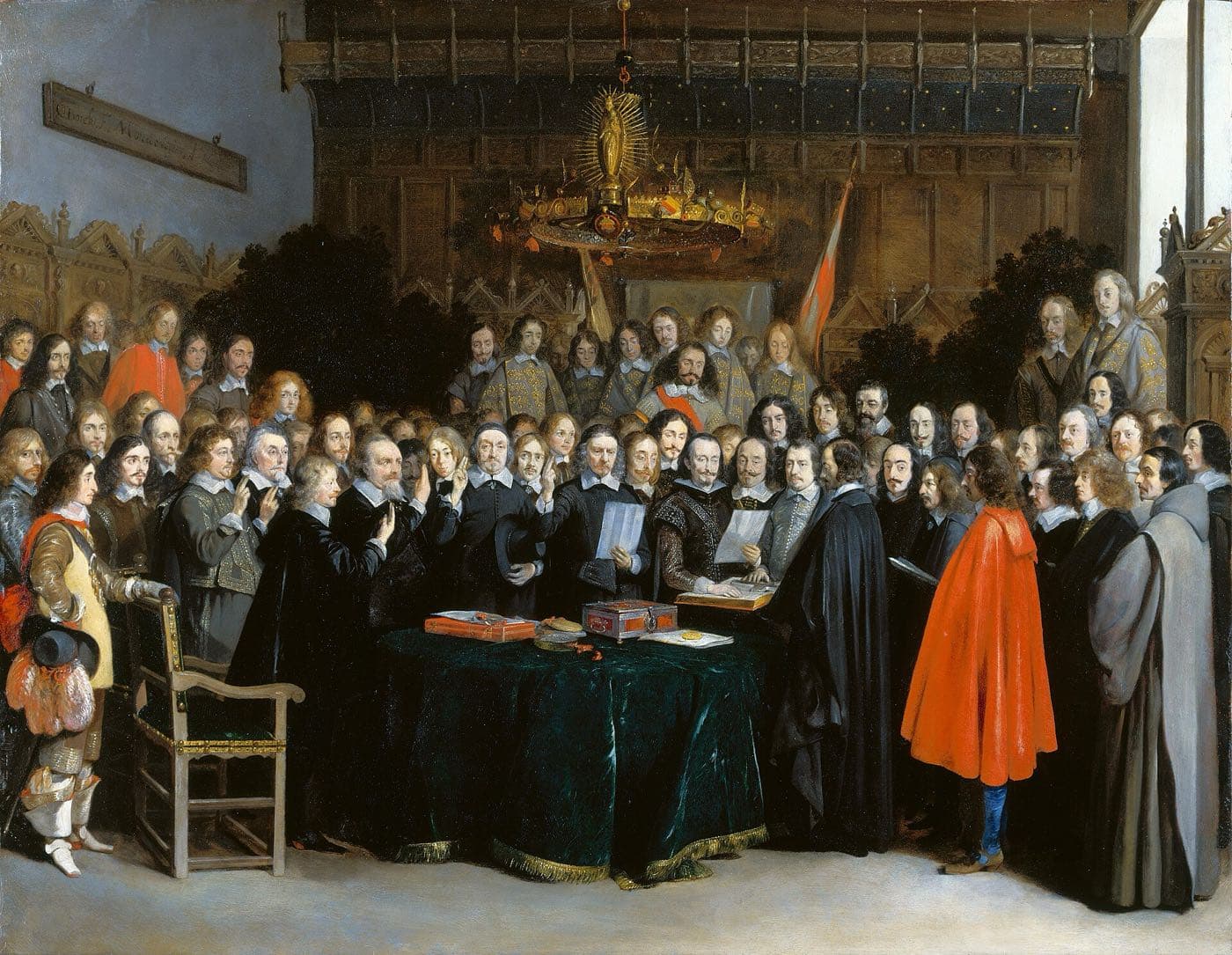
What was the Peace of Westphalia?
The Peace of Westphalia consists of two instruments signed on 24 October 1648 in Münster and Osnabrück: the Instrumentum Pacis Osnabrugense between Emperor, Empire and Sweden, and the Instrumentum Pacis Monasteriense between Emperor, Empire and France. Together they ended the Thirty Years War.
A third treaty belongs to the same round of talks. On 30 January 1648 Spain and the Netherlands made peace in Münster, ending a conflict that had run even longer than the war inside the Empire.
The setup was unusual. This was not two parties arguing over one point, but a whole continent working through a bundle of questions that had become entangled over three decades: confession, constitution, territory, compensation. That is why this gathering counts as the first European peace congress. The Congress of Vienna took the same route to ending a war in 1815.
Who negotiated, and how was it organised?
At the table sat envoys of the Emperor, of Sweden and France, and of the imperial estates, meaning the princes and cities belonging to the Empire. That those estates negotiated in their own right rather than through the Emperor was itself one of the contested questions, and it ended up written into the treaty.
The arrangement solved a practical problem. Because envoys of the Catholic and the Protestant side could not agree on an order of precedence, talks ran in two cities at once: with France in Münster, with Sweden in Osnabrück. Both were declared neutral by the Emperor and demilitarised.
Third parties mediated, among them an envoy of the Pope and the Republic of Venice. Couriers carried drafts between the cities. This ran for five years while the war continued and every battle shifted the positions at the table.
What was agreed?
On confession, the Reformed faith was recognised alongside the Catholic and the Lutheran. For what each confession held, a normative year was fixed, 1 January 1624: whatever applied on that date was to apply again. A matter of faith was thereby turned into a rule of reckoning that could be argued over without negotiating belief itself.
Constitutionally, the imperial estates gained the right to make alliances with outside powers, as long as those were not directed against Emperor and Empire. The Netherlands and the Swiss Confederation left the imperial union. Sweden and France received territory and seats in the imperial diet.
Two provisions made the peace workable: a general amnesty for the acts of the war, and the return of confiscated property. How the armies were to withdraw and be paid was settled only by the Nuremberg execution congress in the two years that followed.
How long did the peace hold?
The arrangements for the Empire held for a good century and a half, until its end in 1806. Wars in Europe continued, but the war of confessions inside the Empire did not return. Measured against the question that had started it, the peace was durable.
Part of the reason lies in its construction. The treaty did not decide the question of faith, it made it negotiable: through the normative year, through procedures for disputes, through the rule that religious matters in the imperial diet were to be settled by agreement rather than by majority. Where a dispute cannot be decided, its rules still can be.
The price was high and had been paid before the peace. In parts of the Empire the war had cost a third of the population and more, emptied whole regions and stretched recovery across generations. The treaty ended the dying; it did not undo it.
What is there to learn from it?
First: you can negotiate while fighting continues. For five years talks and war ran alongside each other. Waiting for the violence to end would not have settled a single question sooner.
Second: a procedure can carry what an agreement cannot. In 1648 the true faith could not be decided. A cut-off date governing what each side held could be decided. That same move, turning an unsolvable dispute into a workable question, stands at the beginning of many successful mediations to this day.
Third: peace does not end with the signature. Only the Nuremberg execution congress settled how the armies withdrew and who paid for them. This unspectacular follow-up work often decides whether a treaty holds. Peace research calls it implementation, and it is the stage at which agreements most often fail.
What changed for people of another faith?
In 1555 the ruler had determined the confession of his territory, and anyone unwilling to follow might have to leave. The treaties of 1648 expressly confirmed the rules of Augsburg but extended them to the Reformed. Three confessions now stood under the protection of imperial law: Catholic, Lutheran and Reformed. Until then the Catholic side had regarded Reformed practice as not covered by the 1555 peace and therefore as illegal.
What was new was a limit on rulers. Subjects no longer had to follow their prince when he changed confession. Under Article V, 34 of the Treaty of Osnabrück, people who professed a religion other than their ruler’s were to be tolerated and allowed to devote themselves to their worship at home with a free conscience, without inquiry or disturbance. Public worship remained restricted, private devotion was protected.
At imperial level a kind of minority protection was added. The Protestants were a minority in the Empire, but could not be outvoted at the Imperial Diet on matters of religion. This was not yet general freedom of religion; the Enlightenment demanded that only in the 18th century. In Augsburg this peace restored to the Protestants the equal status taken from them in 1629, and in 1650 they held their peace festival for the first time.
Did the treaty found the modern state system?
That is how it is often described. The European Commission, which lists Münster and Osnabrück as European Heritage Label sites, calls the peace a decisive event for the development of the modern state and of international law. The City of Münster is more cautious: it laid the, or at least a, foundation stone for the equality of sovereign states regardless of power and size. Political science therefore speaks of the “Westphalian system”.
The historian Heinz Duchhardt considers this role often overstated. Internationally the effect was short-lived: the war between France and Spain continued until the Peace of the Pyrenees in 1659, and the two guarantor powers themselves took up arms again, Sweden in the late 1650s, France in the 1660s. Trading companies and the Hanse still acted in international law after 1648, and there was as yet no equal rank among states.
According to Duchhardt, its importance within the Empire is undisputed. There the treaties applied as fundamental law until 1806 and regulated the relationship between emperor and princes. It is equally certain that the Netherlands and the Swiss Confederation were finally recognised as independent states. And the peace became a point of reference: until the end of the 18th century later peace treaties invoked it. The City of Münster stresses above all the procedures that let opponents deal peacefully with each other despite irreconcilable truths.
What follows from it
They negotiated while the fighting went on. Waiting for violence to stop usually means waiting too long.
Sources
- Regional Association of Westphalia-Lippe, portal on Westphalian history: The Thirty Years War and the Peace of Westphalia 1648 (in German)
- City of Münster: The Peace of Westphalia
- Federal Agency for Civic Education: Heinz Duchhardt, A double “Westphalian System”? The Peace of Westphalia, the Empire and Europe, Aus Politik und Zeitgeschichte
- European Commission, European Heritage Label: Peace of Westphalia (Münster and Osnabrück)
- Osnabrück Peace Talks, Osnabrück University: Osnabrück, City of Peace
- City of Augsburg: High Peace Festival
How it unfolded
- 23 May 1618The Defenestration of Prague opens a war that spreads across much of Europe over three decades.
- December 1641The Hamburg preliminary treaty settles where and on what terms talks are to be held. The venues are fixed before a single substantive question is.
- 1644Negotiations begin. Emperor and Empire talk to France in Münster and to Sweden in Osnabrück, to avoid disputes over precedence.
- 30 January 1648Spain and the Netherlands make peace in Münster. Their eighty years of war end and Dutch independence is recognised.
- 24 October 1648The two peace instruments are signed. They settle territory, confession and the rights of the imperial estates in one text.
- 1649 to 1650The Nuremberg execution congress settles how the armies withdraw and who pays them. Without that step the treaty stays paper.
- Summer 1650The withdrawal of the foreign armies is complete. Only then does the war end on the ground where it was fought.
More in this series
- The Peace of AugsburgFebruary to September 1555When the dispute over faith could not be decided, the parties agreed to stop fighting it out. That makeshift held for more than sixty years
- The Congress of ViennaOctober 1814 to June 1815After more than twenty years of war, the European powers negotiated a new order in Vienna. What came out of it held longer than anything before it
Frequently asked questions
Which wars did the Peace of Westphalia end?
According to the City of Münster, four major wars were intertwined in the Thirty Years’ War. Three of them ended in 1648: the Eighty Years’ War of the Netherlands against Spain, Sweden’s war, and France’s war against the Holy Roman Empire. The war between France and Spain continued and ended only in 1659 with the Peace of the Pyrenees.
Why is Osnabrück called the City of Peace?
The Peace of Westphalia was proclaimed from the steps of Osnabrück town hall in 1648. The conclusion of peace in the town hall is regarded as the outstanding event in the city’s history. To this day the city sees it as a mandate to promote peace and runs its own Office for Peace Culture, which coordinates initiatives for understanding, peace research and human rights.
Who mediated between the envoys?
In Münster the mediators were the papal nuncio Fabio Chigi, later Pope Alexander VII, and Alvise Contarini, chief diplomat of the Republic of Venice. The envoys almost never negotiated directly but passed their papers through the mediators. Because Chigi was not allowed to speak with the Dutch, their proposals also had to go through Contarini.
How did the Pope react to the peace?
The Pope protested sharply against the peace in an official note, because he saw the rights of the Catholic side as having been given up lightly. The Catholic parties signed nonetheless. The City of Münster reads this as follows: the powers no longer accepted a religious arbiter in matters of war and peace.
Why is the Peace of Münster seen as the birth certificate of the Netherlands?
In the Peace of Münster in 1648 Spain recognised the independence of the United Netherlands and ended the Eighty Years’ War, which had begun in 1568. The envoys swore to it on 15 May 1648 in Münster town hall. In Dutch it is called the “Vrede van Munster”, and it is regarded as the birth certificate of the Netherlands.
From history to a mission of your own
Every one of these treaties was the work of people who thought it could be done. The same stance is what it takes on a small scale: in a neighbourhood, a school, a club.
Find your peace mission