How wars ended
The Peace of Augsburg
When the dispute over faith could not be decided, the parties agreed to stop fighting it out. That makeshift held for more than sixty years
Key points at a glance
- The Peace of Augsburg of 25 September 1555 first allowed two confessions side by side for good in the Holy Roman Empire: the old Church and the Lutheran Augsburg Confession.
- It was adopted at the Imperial Diet in Augsburg as part of its final decree, so it was imperial law. King Ferdinand I negotiated for his brother, Emperor Charles V.
- Each territorial ruler, and in imperial cities the city council, chose the confession of their territory. Anyone unwilling to follow could leave with their family and sell their property.
- It held for 63 years without a war of religion. The Reformed stayed excluded and the ecclesiastical reservation stayed disputed until the Peace of Westphalia closed these gaps in 1648.
In numbers
63
years without a war of faith
1555 to 1618
2
recognised confessions
the old church and the Confessio Augustana
1555
proclaimed at Augsburg
at the imperial diet on 25 September
What it achieved
- The old church and the Confessio Augustana were allowed to exist side by side in the Empire.
- For 63 years there was no war of religion in the Empire.
- Nobody had to give up their faith for the war to end.
- Anyone unwilling to follow the confession of their ruler was allowed to move away.
What it left open
- The Reformed faith was not included and was recognised only in 1648.
- The ecclesiastical reservation stayed disputed between the confessions.
- Imperial cities with both confessions got a rule of conduct but no procedure for disputes.
- A right to emigrate is not yet freedom of religion.
What the imperial recess laid down
- The Confessio Augustana counts as lawful alongside the old church.
- Princes and counts determine the confession of their territory.
- Anyone unwilling to follow may move away with wife and children and sell their goods (§ 24).
- In imperial cities where both confessions are practised, both remain (§ 27).
- A bishop or prelate who changes confession loses office and territory (§ 18).
- Period
- February to September 1555
- Place
- Augsburg
- Parties
- King Ferdinand I on behalf of the Emperor, and the ecclesiastical and secular imperial estates of both confessions
- Outcome
- An imperial law of 25 September 1555 recognising the Confessio Augustana alongside the old church
- Author
- Johannes Max Harms
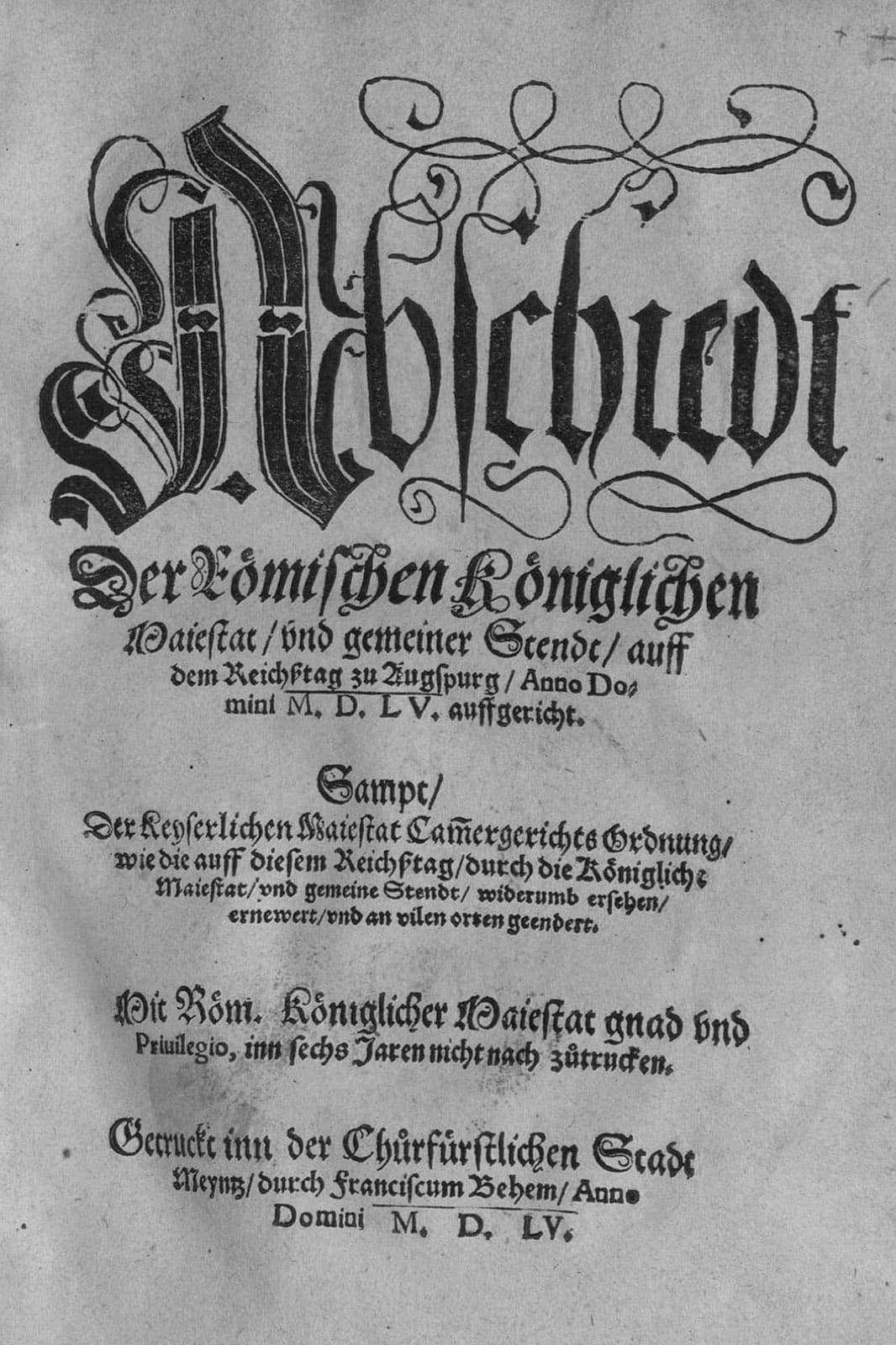
What was the Peace of Augsburg?
The Peace of Augsburg of 25 September 1555 is the first lasting settlement under which two Christian confessions were allowed to exist side by side in the Holy Roman Empire. It was passed at the imperial diet in Augsburg as part of the imperial recess, making it imperial law rather than a treaty between two parties. Among the settlements in this series it is the only one that came about as a law.
Three decades of conflict and one war had come first. In the Schmalkaldic War of 1546 and 1547 the Emperor had tried to settle the question of faith by force and had settled nothing despite military success. The Treaty of Passau of 1552 created a truce and referred the matter to the diet.
What was decided there was neither a reconciliation nor a commitment to toleration. It was an arrangement that took an undecidable dispute out of politics by delegating it to the territorial rulers.
Who negotiated, and why not the Emperor?
At the table sat the imperial estates of both confessions: ecclesiastical and secular princes and the imperial cities. The talks were led by King Ferdinand I, brother of Charles V.
The Emperor himself stayed away. For him, recognising a second confession in the Empire was incompatible with his understanding of his office; he had defended the unity of the church all his life. A year after the religious peace he laid down his rule.
That circumstance is part of the result. The peace came about because the negotiation passed to someone who could conduct it without recanting his own life work. In mediation that is not a footnote but often the condition for anything being signed at all.
What was agreed?
The Confessio Augustana, the Lutheran confession of 1530, was recognised as lawful alongside the old church. Territorial rulers gained the right to determine the confession of their lands. The shorthand about whose realm decides the religion does not come from the text of 1555; it was coined decades later.
For subjects unwilling to follow their ruler's confession, the settlement provided a right to emigrate. By present-day standards that is not freedom of belief, but it was more than had applied before.
Two provisions stayed contested. The ecclesiastical reservation held that a prince-bishop converting to the new confession lost his office and his territory. And the Reformed faith was not included; it was recognised only in 1648. Both gaps turned out to be the fault lines.
How long did the peace hold?
For sixty-three years there was no war of faith in the Empire. Measured against the decades before it and against what came after, that is the remarkable figure about this settlement.
It worked as long as the cases were clear. Where a territory plainly held one confession, the assignment held. Conflict arose where the text left gaps: in ecclesiastical territories, in cities with mixed populations, and among the Reformed, who did not appear in the text and whose numbers grew.
Those unregulated cases piled up over two generations until the institutions of the Empire could no longer absorb them. In 1618 the Thirty Years War began. Its end in 1648 brought no new idea but the same construction with the gaps closed: a cut-off date for holdings, a third recognised confession, procedures for disputes.
What is there to learn from it?
The first finding is encouraging. A question people were willing to fight over could be shut down without being answered. Nobody had to give up their faith for the war to end. It was enough that everyone accepted a rule about who decides what.
The second finding is the warning. A settlement is exactly as stable as its exceptions. The ecclesiastical reservation and the missing recognition of the Reformed were the price of agreement in 1555, and both grew more expensive over decades because no procedure was provided for settling them later.
For any mediation that means: the hard part is not the main clause but the question of what happens to the cases it does not cover. Leaving them open postpones a conflict rather than ending it.
Why did agreement come only in 1555?
There had been many attempts to deal with the religious split since the 1520s. Theologians were brought to the table in religious colloquies to overcome the division in doctrine; that unity has not been restored to this day. Imperial laws, from the Edict of Worms in 1521 to the Augsburg Interim of 1548, tried to ban or contain the new teaching. None of these approaches created lasting legal security for both sides.
A third approach was temporary arrangements: the imperial decree of 1526, the Nuremberg Standstill of 1532, the Frankfurt Standstill of 1539 and the Treaty of Passau of 1552. They renounced force until a next Diet or a council would decide. The historian Axel Gotthard calls this a ceasefire, but not a peace. At Passau an open-ended solution had already been agreed orally, but the emperor did not ratify it.
Three years later the situation had changed. The Princes’ Revolt, an uprising of Protestant princes joined by the French king, was followed by the bloody Margraves’ War in Franconia. Many participants in the Diet feared for the survival of the Empire and now wanted peace at any price. By the summer of 1555 Charles V was already at his Spanish retreat. What was new above all was the order: political peace first, without prior agreement in faith.
What applied in the imperial cities?
For the principalities the rule was simple: the ruler chose, the land followed. For the free and imperial cities the text made a separate provision. Where both confessions had been in use until then, they were to remain so. Citizens and residents were to live “peacefully and quietly beside and with one another”, and neither side was allowed to take away the other’s religion, church customs or ceremonies.
What sounds obvious today caused great complications at the time. Almost all imperial cities had turned Protestant early. In some there were only small Catholic remnants, or the Augsburg Interim had forced Catholic practice back in. The provision therefore mainly protected Catholic minorities in a largely Protestant setting. How church buildings and city offices were to be shared between the groups, the text did not say.
In addition, religion was lived in public at the time. Many saw a procession of the minority in front of their own house as a provocation, and in many places insults and brawls followed. The article set a rule of conduct, but no procedure for disputes. Augsburg itself felt the consequences: on 8 August 1629, in the middle of the Thirty Years’ War, the city’s Protestants were forbidden to practise their faith. They regained equal status only with the peace of 1648.
What follows from it
A dispute can be shut down without being decided. How long that holds depends on how precisely the exceptions are settled.
Sources
- German Federal Agency for Civic Education: 1555, the first religious peace (in German)
- German Federal Agency for Civic Education: From the 95 theses to the Peace of Augsburg, Aus Politik und Zeitgeschichte (in German)
- Regional Association of Westphalia-Lippe, Westphalian History internet portal: Augsburg imperial decree of 25 September 1555 (source text)
- City of Augsburg: High Peace Festival
- Austrian Commission for UNESCO: Decree of the Diet of Augsburg 1555, Peace of Augsburg
- Protestant Church in Germany, Luther 2017: 1555, opening of the Diet of Augsburg
- Evangelical Lutheran Deanery of Augsburg: Martin Luther in Augsburg
How it unfolded
- 1530The Confessio Augustana is presented at the Augsburg diet, the confession whose recognition will be fought over for a quarter of a century.
- 1546 to 1547In the Schmalkaldic War the Emperor tries to settle the question of faith by force. Victory in the field does not end the dispute.
- August 1552The Treaty of Passau creates a provisional peace and refers the decision to the next imperial diet.
- February 1555The diet convenes at Augsburg. Charles V stays away; his brother Ferdinand I leads the talks.
- 25 September 1555The religious peace is proclaimed as part of the imperial recess. It stands as imperial law, not as a treaty between two parties.
- From 1555The ecclesiastical reservation, under which a converting prince-bishop loses his office, remains contested between the confessions.
- 1618The Defenestration of Prague opens the Thirty Years War. It ends in 1648 with a settlement built on the one of 1555.
More in this series
- The Peace of Westphalia1644 to 1648Envoys negotiated in two cities for five years while the war went on. What came out of it is still treated as a model for talks between enemies
- The Good Friday AgreementJune 1996 to May 1998After three decades of violence, two governments and eight parties agreed on an order that the public then voted on
Frequently asked questions
What does “cuius regio, eius religio” mean?
The Latin formula roughly means: whose the realm, his the religion. The ruler of a territory, or the city council in an imperial city, determined its confession. The formula does not appear in the text of 1555; it was coined later to sum up the rule. A German rhyme for it says “wo ich leb, so ich bet”, where I live, so I pray.
What is Martin Luther’s connection to Augsburg?
Luther came to Augsburg in October 1518 to answer to the papal envoy Cardinal Cajetan, and stood by his teaching. During the Diet of 1530 he was not in the city but at Veste Coburg castle. From there he stayed in contact with Philipp Melanchthon when the Augsburg Confession was read out before Charles V on 25 June 1530.
Why is 8 August a public holiday in Augsburg?
On 8 August Augsburg celebrates the High Peace Festival, a holiday that applies only within the city. It recalls 8 August 1629, when the city’s Protestants were forbidden to practise their faith. After the Peace of Westphalia they celebrated the festival for the first time in 1650. It has been an official holiday since 1950 and intangible cultural heritage since 2018.
Who was excluded from the Peace of Augsburg?
Everyone who belonged neither to the old Church nor to the Augsburg Confession was excluded. The text states that they were “not meant, but entirely excluded” from this peace. This affected above all the followers of Calvin, whose practice the Catholic side considered illegal in the Empire. The Reformed faith was recognised only in 1648.
Where can you read the text of the Peace of Augsburg?
The Peace of Augsburg is part of the Augsburg imperial decree of 25 September 1555. An engrossed copy is held by the Austrian State Archives and was added in 2016 to Austria’s register of UNESCO documentary heritage. The wording of the religious articles is freely available online on the Westphalian History internet portal of the Regional Association of Westphalia-Lippe, with headings for each section.
From history to a mission of your own
Every one of these treaties was the work of people who thought it could be done. The same stance is what it takes on a small scale: in a neighbourhood, a school, a club.
Find your peace mission