How wars ended
The Minsk Agreements
Two agreements, thirteen points, seven years of talks. In the end the dispute was not about the text but about the order of its steps
Key points at a glance
- The Minsk Agreements are two documents meant to end the fighting in eastern Ukraine: the protocol of 5 September 2014 with twelve points and the package of measures of 12 February 2015 with thirteen.
- They were signed by the Trilateral Contact Group of representatives of the OSCE, Ukraine and Russia, together with representatives of the self-proclaimed entities in Donetsk and Luhansk.
- The UN Security Council endorsed the package of measures unanimously on 17 February 2015 in resolution 2202.
- No ceasefire held for good, and the political points were never implemented. With the events of February 2022 the framework became void.
In numbers
13
points in the package of measures
of 12 February 2015
2
agreements
September 2014 and February 2015
7
years of negotiation
2014 to 2021, without a political conclusion
- Artillery of 100 millimetre calibre and above50 km
- Multiple rocket launchers70 km
- Heavy rocket launchers and tactical missiles140 km
Ceasefire
From 15 February 2015, midnight local time, a comprehensive ceasefire applies in parts of the Donetsk and Luhansk regions.
Withdrawal of heavy weapons
The withdrawal starts on day two at the latest and is to be completed within 14 days. The OSCE monitors it.
Prisoners and amnesty
All prisoners are exchanged on the principle of “all for all”, and a law rules out prosecution for the events.
Special status
Within 30 days the Ukrainian parliament specifies the areas to which a special order of self-government is to apply.
Constitutional reform
By the end of 2015 a new constitution enters into force, with decentralisation as a key element.
Local elections
Elections in the areas follow OSCE standards and are monitored by its Office for Democratic Institutions and Human Rights.
Control of the border
Ukraine takes over the state border from the day after the elections, and fully only after the overall political settlement.
- Period
- September 2014 to February 2022
- Place
- Minsk
- Parties
- The Trilateral Contact Group of Ukraine, Russia and the OSCE, from 2015 accompanied by the Normandy format with Germany and France
- Outcome
- A protocol of 5 September 2014 and a package of measures of 12 February 2015, both only partly implemented
- Author
- Johannes Max Harms
What were the Minsk Agreements?
The Minsk Agreements are two documents meant to end the war in eastern Ukraine. The first, a twelve-point protocol, was signed on 5 September 2014 and supplemented by a memorandum two weeks later. The second, a thirteen-point package of measures, followed on 12 February 2015. It is often called Minsk II.
Both were signed by the Trilateral Contact Group of representatives of Ukraine, Russia and the OSCE, together with representatives of the self-proclaimed entities in Donbas. The second agreement emerged from a night of talks in the Normandy format, which also included Germany and France.
Unlike the other entries in this series, Minsk is not a peace treaty. It is a negotiating framework of ceasefire, security steps and political commitments whose parts were meant to build on each other.
Who negotiated, and in what format?
Ukraine, Russia and the OSCE sat at the table of the Contact Group. The OSCE also provided the monitoring mission meant to observe the ceasefire, without any power to enforce it.
Alongside it stood the Normandy format of the heads of state and government of Ukraine, Russia, Germany and France. It negotiated the political lines but was not itself a signatory of what was decided in Minsk. The four backed the package of measures in a declaration of their own, which the UN Security Council attached to its resolution as a second annex.
This split between those who negotiated and those who signed is one of the points that analyses in the Ukraine-Analysen of Germany’s Federal Agency for Civic Education name as a weakness of the process. There was no mechanism by which a violation would have had consequences.
What was agreed?
The security part provided for an immediate ceasefire, the withdrawal of heavy weapons from security zones 50 to 140 kilometres wide, monitoring by the OSCE, the exchange of prisoners, humanitarian access and the withdrawal of all foreign armed formations.
The political part required Ukraine to carry out a constitutional reform with decentralisation and a special status for parts of Donbas, plus local elections under Ukrainian law monitored by the OSCE. At the end of that path Ukraine was to regain control of its state border.
It was precisely this sequence that set off the dispute that blocked the process for years. One reading demanded security and border control first and elections afterwards; the other demanded elections and special status first and the border afterwards. Both readings could be argued from the same text.
How long did the arrangement hold?
The agreed ceasefire never held completely. Between 2015 and 2021 new ceasefires were agreed repeatedly; some held for weeks or months, none for good.
The political points were not implemented. Neither the constitutional reform nor the elections nor the return of border control took place. The process continued until 2021 without conclusion.
In February 2022 the framework came to a final end when the self-proclaimed entities were recognised and the attack on Ukraine began. What happened after that does not belong in this series: it describes agreements, not ongoing wars.
What can be learned from it?
The first finding concerns language. A text deliberately left open so that everyone can sign moves the dispute from the negotiation into the implementation. There it is harder to resolve, because there is no longer a table at which it could be settled.
The second finding concerns enforcement. An agreement without a mechanism that ties violations to consequences rests solely on the parties wanting it. The OSCE could observe and report, nothing more.
The third finding comes from comparison within this series. The Good Friday Agreement tied the disputed question to a procedure and let the population vote on it. Dayton wrote down an order and put a force behind it. Minsk had neither. That is not a judgement on those involved but a statement about the design.
How was the border tied to the elections?
Point 9 of the package of measures deals with the state border. Ukraine was to regain full control of it throughout the conflict area, starting on the first day after the local elections and ending after a comprehensive political settlement. That settlement consisted of the elections and the constitutional reform, which was to be finished by the end of 2015.
The reform in turn came with conditions. Under point 11 it was to reflect the specific features of the areas, agreed with their representatives. A footnote lists what the law on the special order of self-government provides, including exemption from punishment for those involved, linguistic self-determination, a say in the appointment of prosecutors and judges, and local units of a people’s police.
So each political step hung on the one before. Johannes Regenbrecht, who was responsible for Ukraine at the German Foreign Office from 2014 to 2016, therefore describes the restoration of sovereignty in his analysis for the Ukraine-Analysen as doubly conditioned: by agreeing Ukrainian legislation with the representatives of the areas, and by the proper conduct of elections in areas Ukraine did not control.
What did the OSCE monitoring mission do?
The OSCE Special Monitoring Mission to Ukraine began its work on 21 March 2014, at the request of the Ukrainian government and after a decision by all 57 participating States. It was an unarmed, civilian mission present on the ground around the clock. Its task was to report impartially on the security situation and to facilitate dialogue among all parties to the conflict.
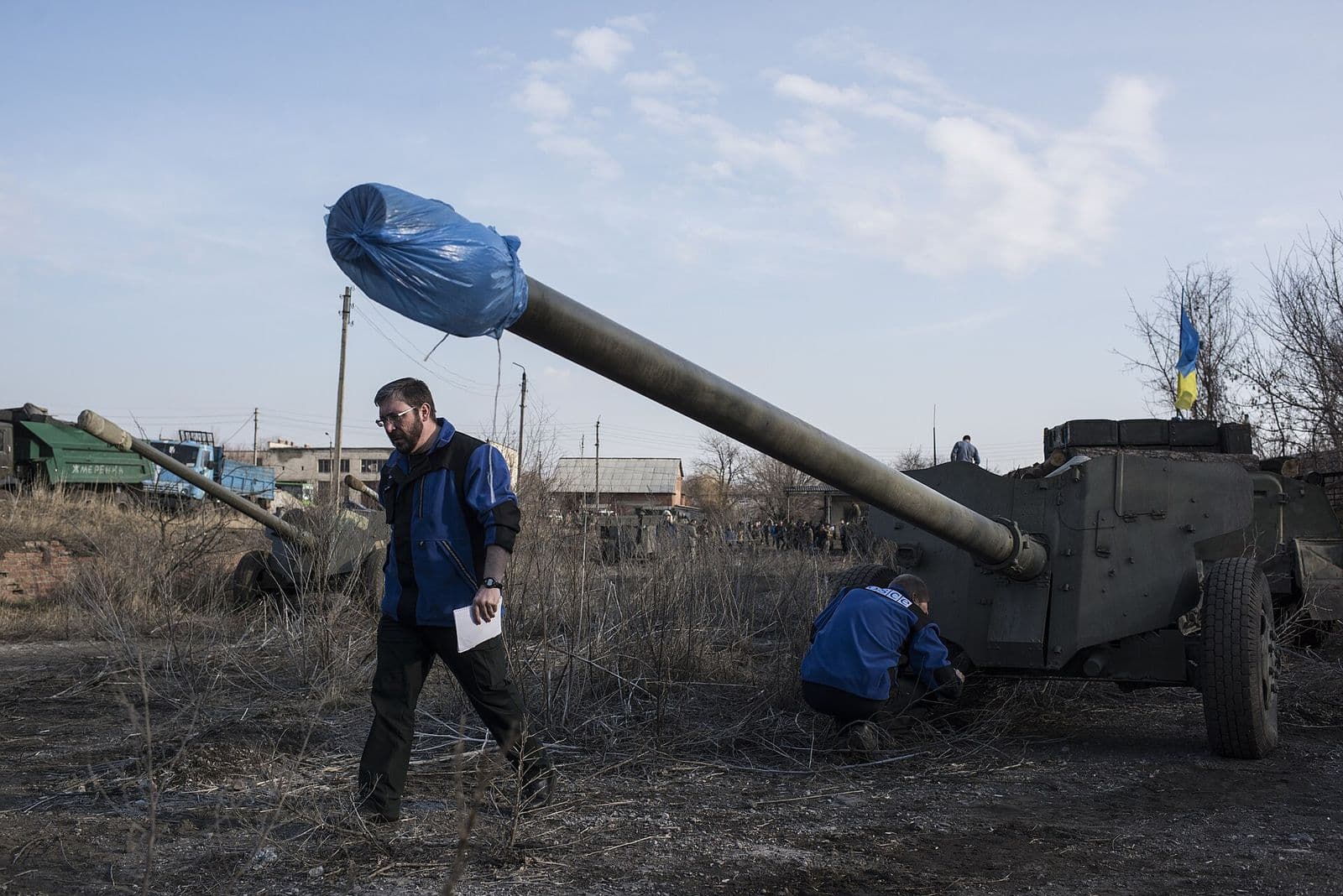
The Minsk Agreements gave it additional tasks. Under point 3 of the package of measures it was to monitor the ceasefire and the withdrawal of heavy weapons from day one, using satellites, drones and radar. The photo above shows such checks in February 2015.
It could enforce nothing. It observed, counted and reported, including on violations, without any consequence following. On 31 March 2022 it ended its work because the participating States could not reach consensus on extending its mandate.
What follows from it
When two sides read a different order out of the same text, the agreement has not yet been reached, only written down.
Sources
- German Federal Agency for Civic Education (bpb): documentation, the Minsk agreement of 12 February 2015 (in German)
- German Federal Agency for Civic Education (bpb): documentation, the Minsk protocol of 5 September 2014 (in German)
- German Federal Agency for Civic Education (bpb): documentation, the Minsk memorandum of 19 September 2014 (in German)
- German Federal Agency for Civic Education (bpb), Ukraine-Analysen: the Minsk agreement of 2015, ten lessons (in German)
- United Nations: Security Council resolution 2202, 17 February 2015
- OSCE: Special Monitoring Mission to Ukraine (closed)
- Office of the UN High Commissioner for Human Rights: Conflict-related civilian casualties in Ukraine, as of 31 December 2021
How it unfolded
- March 2014On 21 March all 57 OSCE participating States decide to send a civilian Special Monitoring Mission to Ukraine.
- April 2014Armed clashes begin in eastern Ukraine and turn into a lasting war.
- 5 September 2014The Trilateral Contact Group signs a twelve-point protocol in Minsk. The ceasefire does not hold.
- 19 September 2014A memorandum sets out details of implementation, including a buffer zone at least 30 kilometres wide and the withdrawal of heavy weapons.
- 12 February 2015After a night of talks in the Normandy format, the thirteen-point package of measures is agreed and signed by the Contact Group.
- 17 February 2015The UN Security Council unanimously endorses the package of measures and calls on all parties to implement it fully.
- 2015 to 2021Ceasefires are agreed again and again and broken again and again. The political points of the package are not implemented.
- February and March 2022With the recognition of the self-proclaimed entities in Donbas and the attack on Ukraine that followed, the framework becomes void. The OSCE mission ends on 31 March.
More in this series
- The Good Friday AgreementJune 1996 to May 1998After three decades of violence, two governments and eight parties agreed on an order that the public then voted on
- The Dayton AgreementNovember to December 1995Three weeks sealed off on an air force base, and at the end not merely a ceasefire but the constitution of a state
Frequently asked questions
Who signed the Minsk Agreements?
The package of measures of 12 February 2015 bears the names of the Trilateral Contact Group: Ambassador Heidi Tagliavini for the OSCE, former Ukrainian president Leonid Kuchma, the Russian ambassador to Ukraine Mikhail Zurabov, and Alexander Zakharchenko and Igor Plotnitsky for the self-proclaimed entities in Donetsk and Luhansk. The same people had already signed the protocol of September 2014.
What is Minsk II?
Minsk II is the usual short name for the package of measures for the implementation of the Minsk Agreements of 12 February 2015. It was meant to replace the first agreement of September 2014 and make it workable after its ceasefire had failed to hold.
What did the UN Security Council decide on Minsk?
On 17 February 2015 the Security Council unanimously adopted resolution 2202. In it the Council endorsed the package of measures, welcomed the declaration of the heads of state and government of Russia, Ukraine, France and Germany, and called on all parties to implement the package fully, including a comprehensive ceasefire.
How many people died in Donbas by the end of 2021?
The Office of the UN High Commissioner for Human Rights estimates the number of people killed from 14 April 2014 to 31 December 2021 at 14,200 to 14,400. At least 3,404 of them were civilians. The figures cover the whole period in which the Minsk Agreements applied.
Why are the agreements named after Minsk?
Because the Trilateral Contact Group met in the Belarusian capital. The protocol and the memorandum of September 2014 were signed there, and it was there that the leaders of the Normandy format negotiated through the night in February 2015.
From history to a mission of your own
Every one of these treaties was the work of people who thought it could be done. The same stance is what it takes on a small scale: in a neighbourhood, a school, a club.
Find your peace mission