How wars ended
The Dayton Agreement
Three weeks sealed off on an air force base, and at the end not merely a ceasefire but the constitution of a state
Key points at a glance
- The Dayton Agreement ended the war in Bosnia and Herzegovina, which lasted from April 1992 to the end of 1995 and, by estimates, cost around 100,000 lives.
- It was negotiated in November 1995 at Wright-Patterson Air Force Base near Dayton, Ohio, and formally signed in Paris on 14 December 1995.
- Bosnia and Herzegovina, Croatia and Serbia sat at the table. The United States mediated and pressed the warring parties into an agreement.
- Annex 4 remains the state’s constitution today: two entities, a three-member presidency and a High Representative who oversees implementation.
In numbers
21
days of talks
sealed off on an air force base
11
annexes
one of them is the constitution of the state
30
years without a new war
since December 1995
- IFOR, from December 199560,000
- SFOR, at the start31,000
- SFOR, early 200119,000
- SFOR, 20047,000
The provisions
- Bosnia and Herzegovina remains one state within its borders.
- Two entities, the Federation and Republika Srpska, with their own governments, parliaments and police.
- A three-member presidency and a parliament whose seats are distributed by three constituent peoples.
- A High Representative oversees civilian implementation.
- Eleven annexes cover troop withdrawal, elections, the return of refugees and police reform. Annex 4 is the constitution.
- An international force of some 60,000 troops secures the separation of the armies.
- Period
- November to December 1995
- Place
- Dayton, Ohio, and Paris
- Parties
- Bosnia and Herzegovina, Croatia and Serbia, mediated by the United States with the European Union and Russia involved
- Outcome
- A framework agreement with eleven annexes, initialled on 21 November 1995 and signed on 14 December 1995 in Paris
- Author
- Johannes Max Harms
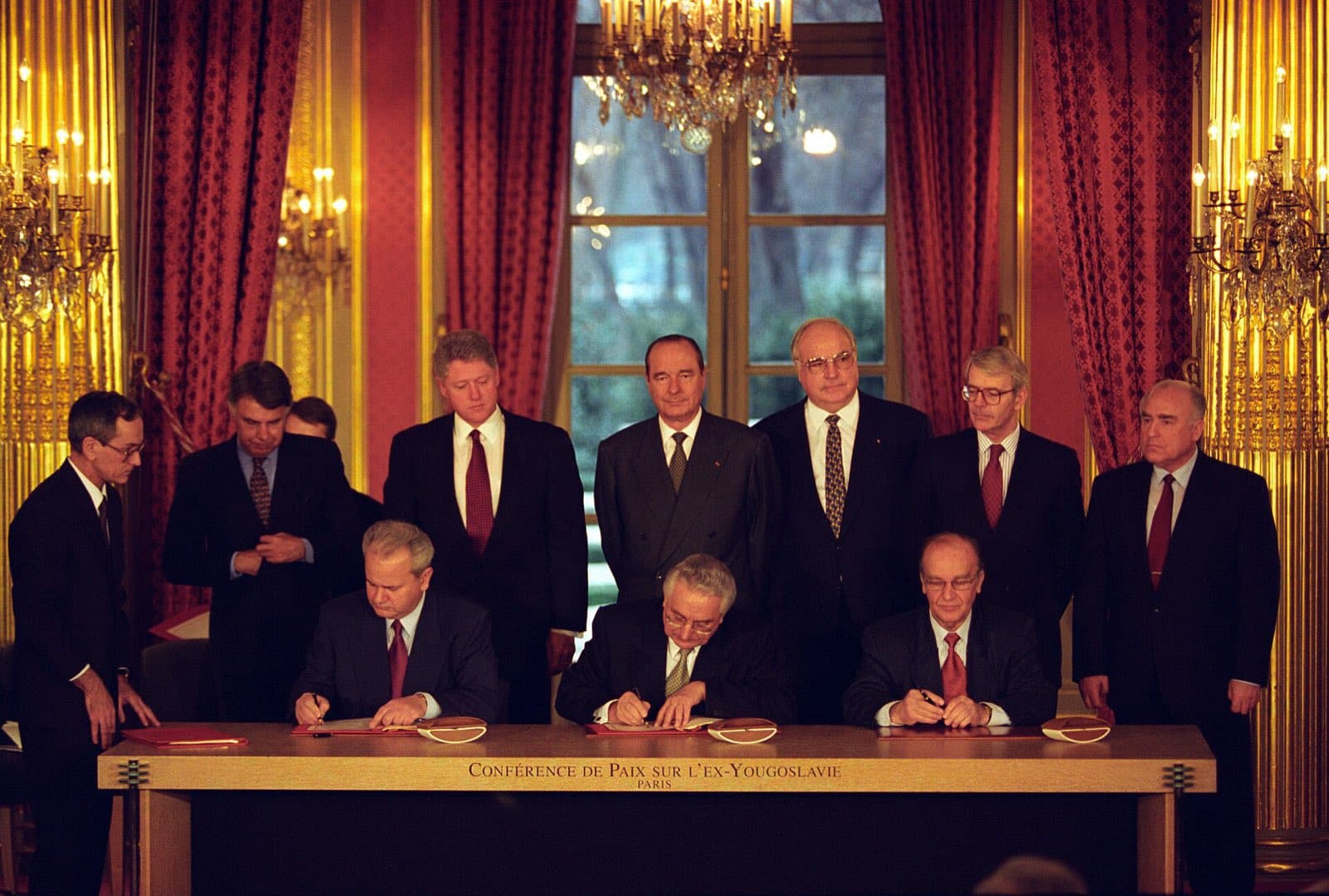
What was the Dayton Agreement?
The General Framework Agreement for Peace in Bosnia and Herzegovina ended the war that had run since April 1992. Talks were held from 1 to 21 November 1995 at an air force base in Dayton, Ohio; the signing took place on 14 December 1995 in Paris.
At the table sat the presidents of Bosnia and Herzegovina, Croatia and Serbia. The United States led the mediation, with the European Union and Russia involved.
The agreement is more than a peace settlement in the narrow sense. It includes eleven annexes covering everything from troop withdrawal through elections and the return of refugees to policing. Annex 4 is the constitution of the state. A country thereby received its basic order as part of an international treaty.
Who negotiated, and under what conditions?
The venue was part of the method. A sealed-off military base in the United States held the delegations together for three weeks, without press and without the option of ending talks by walking out. The same technique had worked at Camp David in 1978.
The population of the country whose order was being settled took no part in the talks, and there was no vote on the result. That is the sharpest contrast with the Good Friday Agreement three years later, which was confirmed by two referendums.
What made talks possible was a changed situation in the summer and autumn of 1995, including the genocide at Srebrenica in July, which shifted the international stance fundamentally, and a ceasefire in October.
What was agreed?
Bosnia and Herzegovina remains one state within its borders but consists of two entities: the Federation of Bosnia and Herzegovina with about 51 per cent of the territory and the Republika Srpska with about 49 per cent. Each has its own government, parliament and police.
At state level there is a three-member presidency and a parliament whose seats are distributed by membership of three constituent peoples. Alongside them stands a High Representative of the international community who oversees civilian implementation with far-reaching powers.
Militarily, an international force of some 60,000 troops secured the separation of the armies and their withdrawal behind the agreed lines. That task was done within months; the civilian implementation continues.
How long did the peace hold?
Thirty years. The war has not returned, and by that measure the agreement met its first aim: it stopped the killing.
The second aim, a working common state, is harder to assess. The order that stopped the killing fixed the division along the same lines that had been fought over. Decisions at state level require the assent of all three sides, which makes deadlock the normal form of politics.
That the office of the High Representative still exists three decades after the treaty is the soberest finding about this construction. It carries the peace and has not yet made itself unnecessary.
What is there to learn from it?
Dayton ended a war in which every earlier mediation had failed. That it worked hung on three things: a changed military situation, a sealed-off venue and a mediator with means of its own. None of them was a problem of text.
The second finding is uncomfortable. An order built along the lines of a conflict makes those lines permanent. Making membership of a group the condition for holding office keeps alive the very division the conflict grew out of.
For practice that does not mean Dayton was wrong. It means an agreement has two clocks. One measures whether the violence stops, the other whether a society can do without the treaty. The second runs slower, and it is rarely read at the signing.
Why did war break out in Bosnia and Herzegovina?
In socialist Yugoslavia, Bosnia and Herzegovina was one of six republics and the only one in which no national group held an absolute majority. It was home to Orthodox Serbs, Catholic Croats and Muslims, who had been recognised as a national group with equal standing since the 1960s. When Slovenia and Croatia declared independence in 1991, the question of where Bosnia and Herzegovina belonged became a matter of survival for the whole republic.
In a referendum in spring 1992 the majority voted for an independent state. The leading Bosnian Serb party had called for a boycott. Independence became the trigger for the war, which began in April 1992. On one side fought nationalist Bosnian Serbs backed by Serbia, and later also nationalist Bosnian Croats backed by Croatia. Their aim was to divide the country and attach territory to the neighbouring states.
On the other side stood the government in Sarajevo, supported above all by Bosnian Muslims, officially called Bosniaks since 1993, but also by Serbs and Croats who wanted a shared state. The war was waged with “ethnic cleansing”, expulsions and mass murder. In July 1995 Bosnian Serb units murdered more than 8,000 Bosnian Muslims in Srebrenica, a crime that international courts later classified as genocide.
Who secured the ceasefire militarily?
The military situation had already changed before the negotiations. In September 1995 NATO carried out air strikes on Bosnian Serb positions in Operation Deliberate Force. The Office of the Historian at the US Department of State counts these strikes among the key factors that made the talks at Dayton possible in the first place. After the signing, NATO also took over implementation of the military parts of the agreement.
In December 1995 the Implementation Force, IFOR for short, moved in with 60,000 soldiers and a one-year mandate. Its basis was UN Security Council Resolution 1031 of 15 December 1995. This allowed the force not only to keep the peace but, where necessary, to enforce it. IFOR separated the armed forces of the two entities and oversaw the transfer of territory between them and the marking of the boundary line.
A year later the Stabilisation Force, SFOR for short, took over, initially with 31,000 soldiers, 19,000 by early 2001 and 7,000 in 2004. In total 36 NATO member and partner countries contributed troops, with soldiers from five further countries as well. The mission ended on 2 December 2004. It was replaced by a European Union force, Operation Althea, which NATO supports with planning and logistics.
What follows from it
An agreement can end a war and at the same time fix in place the division that caused it. Both are in the same text.
Sources
- German Federal Agency for Civic Education: The Dayton peace agreement (in German)
- German Federal Agency for Civic Education, war and peace: the Dayton peace agreement (in German)
- NATO: Peace support operations in Bosnia and Herzegovina (1995 to 2004)
- Federal Agency for Civic Education (bpb), South-eastern Europe: Bosnia and Herzegovina
- OSCE Mission to Bosnia and Herzegovina: Dayton Peace Agreement
- Office of the Historian, US Department of State: The Evolution of NATO
How it unfolded
- April 1992War begins in Bosnia and Herzegovina. It lasts three and a half years and costs around 100,000 lives.
- July 1995The genocide at Srebrenica fundamentally changes the international stance towards the war.
- October 1995A ceasefire takes effect and creates the precondition for any negotiation at all.
- 1 November 1995Talks begin at Wright-Patterson Air Force Base in Dayton. The delegations are effectively unable to leave the grounds.
- 21 November 1995After three weeks the agreement is initialled. It comprises a framework and eleven annexes.
- 14 December 1995The formal signing takes place in Paris. An international force of some 60,000 troops secures implementation.
- Since 1996A High Representative oversees the civilian side. The office exists to this day, which says more about the construction than any comment.
More in this series
- The Good Friday AgreementJune 1996 to May 1998After three decades of violence, two governments and eight parties agreed on an order that the public then voted on
- The Camp David AccordsSeptember 1978 to March 1979Thirteen days without an audience, a mediator who would not let the parties leave, and at the end the first peace between Israel and an Arab state
Frequently asked questions
What does Dayton refer to?
Dayton is a city in the US state of Ohio. Near it lies Wright-Patterson Air Force Base, where the negotiations took place in November 1995. The agreement is usually named after the place. Its official title is the General Framework Agreement for Peace in Bosnia and Herzegovina. Because it was signed in Paris, it is also called the Dayton-Paris Agreement.
How many people died in the Bosnian War?
By estimates, around 100,000 people had died by the end of the war in 1995, most of them from the Muslim population. In the Srebrenica genocide of July 1995 alone, Bosnian Serb units murdered more than 8,000 Bosnian Muslims. Victims of these massacres are still being identified and buried at the annual commemorations in Potočari.
What was Bosnia and Herzegovina before 1992?
A republic within Yugoslavia. Bosnia and Herzegovina has existed as a modern independent state only since 1992. In the late Middle Ages there was a Kingdom of Bosnia and, in the south, a duchy that gave Herzegovina its name. After Ottoman rule the territory was occupied by Austria-Hungary in 1878, annexed in 1908 and, after 1945, became one of the six republics of socialist Yugoslavia.
What is the Brčko District?
Brčko is a small district in the north of the country. Officially it belongs to both entities, the Federation of Bosnia and Herzegovina and Republika Srpska, but in practice it works as a separate special administrative area. Bosnia and Herzegovina today therefore consists of two entities and this self-governing district.
Were the war crimes prosecuted?
Yes. In 1993 the United Nations set up the International Criminal Tribunal for the former Yugoslavia in The Hague to prosecute the crimes of the wars. The tribunal was created while the war was still going on, two years before the agreement. By the time it closed in 2017, it had convicted 90 senior figures.
From history to a mission of your own
Every one of these treaties was the work of people who thought it could be done. The same stance is what it takes on a small scale: in a neighbourhood, a school, a club.
Find your peace mission