How wars ended
The Peace of Tilsit
Prussia lost half its state and kept its existence only because a third party at the table wanted it kept
Key points at a glance
- The Peace of Tilsit consists of two treaties of July 1807: France concluded it with Russia on 7 July and with Prussia on 9 July.
- It ended the War of the Fourth Coalition that Prussia and Russia fought against France. Napoleon negotiated with the tsar as an equal and dictated the terms to Prussia.
- Prussia lost more than half of its territory and almost half of its inhabitants, including everything between the Rhine and the Elbe and the former Polish provinces.
- The treaty held until 1813. In those years the Prussian reforms began, from the October Edict freeing the peasants in 1807 to the rebuilding of the army.
In numbers
1/2
of the territory lost
along with much of the population
42,000
ceiling on the army
set only in 1808 by the Treaty of Paris
6
years in force
1807 until the rising of 1813
- ceded1/2
- kept1/2
Kingdom of Westphalia
- What it received
- Prussia’s possessions between the Rhine and the Elbe
- Who ruled
- King Jérôme, Napoleon’s youngest brother
- Treaty articles
- VI to VIII
Duchy of Warsaw
- What it received
- Prussia’s former Polish provinces
- Who ruled
- The King of Saxony
- Treaty articles
- XIII and XV
Danzig
- What it received
- The city with two miles of surrounding land
- Who ruled
- Free city, under French occupation
- Treaty articles
- XIV and XIX
Russia
- What it received
- A border strip along the Bug and Narew
- Who ruled
- Tsar Alexander I
- Treaty articles
- XVIII
- Period
- July 1807
- Place
- Tilsit on the Memel
- Parties
- France under Napoleon, Russia under Tsar Alexander I and Prussia under Frederick William III
- Outcome
- Two treaties, with Russia on 7 and with Prussia on 9 July 1807, taking about half of Prussian territory
- Author
- Johannes Max Harms
What was the Peace of Tilsit?
In July 1807 the war between France, Russia and Prussia ended at Tilsit in East Prussia. Two treaties were concluded: on 7 July between France and Russia, on 9 July between France and Prussia.
A military collapse had come first. The twin battles of Jena and Auerstedt in October 1806 had effectively decided the war for Prussia in a day; the defeat of the Russian army at Friedland in June 1807 took from the last ally the means to fight on.
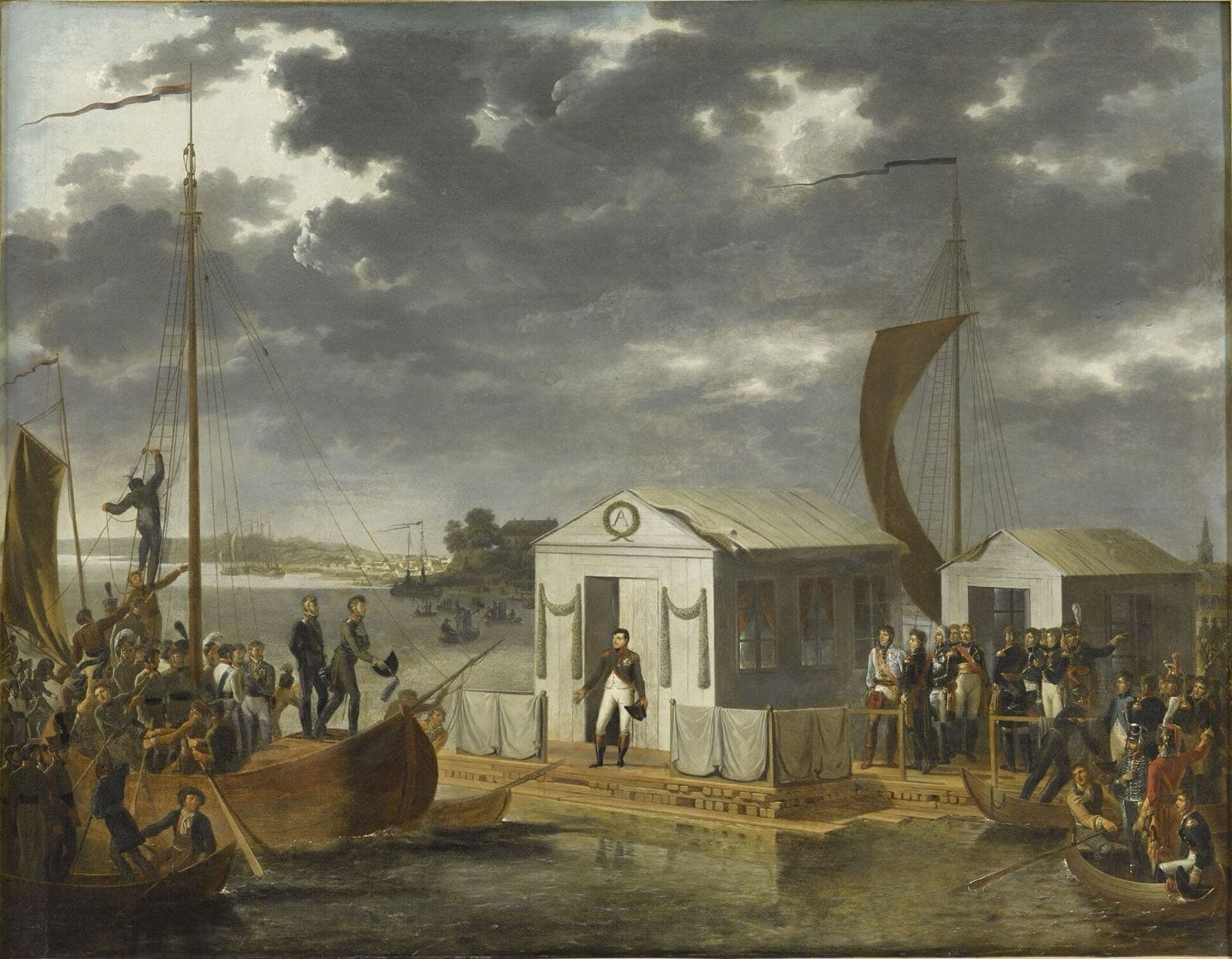
What was negotiated at Tilsit concerned Prussia without Prussia. Napoleon and Tsar Alexander I first spoke alone, on a raft moored in the river Memel. The Prussian king waited on the bank.
Who negotiated, and who was negotiated over?
Two parties negotiated: Napoleon and Alexander I. Both had reason to come to terms. France wanted Russia out of the coalition, Russia wanted the war over without losing territory itself.
Prussia was subject matter, not party. That the country remained a state at all came down to the Tsar, who insisted on it. Without that intervention the Prussian monarchy would probably have been partitioned in 1807.
Queen Louise meeting Napoleon on 6 July is among the best-known scenes of this peace and changed nothing about the result. It is an example of how little personal appeal achieves once the question of power has already been settled.
What was agreed?
Prussia lost about half its territory. The lands west of the Elbe went to the newly formed Kingdom of Westphalia, the Polish provinces acquired in the partitions to the Duchy of Warsaw.
When and how Prussia could take back the restored places and their administration the treaty left open, referring to separate arrangements. That kept the country dependent on decisions still to be made. The ceiling of 42,000 men for the army did not come at Tilsit but in September 1808 with the Treaty of Paris.
Russia, by contrast, lost nothing and gained a partner. The same day of negotiation therefore produced opposite results for the two other parties, which says less about negotiating skill than about the situation beforehand.
How long did the peace hold?
Six years. In 1812 Napoleon's campaign against Russia failed, and in 1813 Prussia re-entered the war. The treaty of Tilsit was finished.
In those six years, though, something happened that outlasted the treaty. From October 1807 a series of reforms began in Prussia: the end of hereditary subjection, municipal self-government with elected representatives, a rebuilding of administration and army, the founding of the university in Berlin in 1810.
The reforms were not a programme born of insight but an answer to defeat. A state permitted only 42,000 men under arms from 1808 had to find its strength elsewhere, and the army reform laid the ground for what followed in 1813.
What is there to learn from it?
The first sentence is the hardest in this series on peace settlements: whoever is not at the table is on the agenda. Prussia was negotiated over in 1807, not included, and the survival of its own state hung on a third party's interest.
The second finding does not soften the first but adds to it. A dictated peace fixes the terms, not what the defeated side makes of them. The Prussian reforms happened inside the limits of that treaty, not against them.
Read together for today: a result one side was not allowed to shape is not a peace but a pause. And what happens during that pause helps decide what comes next.
How did Prussia end up in the war of 1806?
With the Peace of Basel in 1795 Prussia had left the first coalition against revolutionary France. The territories it gained in the same year through the third partition of Poland mattered more to it than its allies. Under King Frederick William III a policy of neutrality followed that increasingly isolated the country. The king did not dare to stand up to Napoleon.
In December 1805 he felt compelled into an alliance with Napoleon. In return for Prussian territorial cessions, Napoleon offered him the Electorate of Hanover in exchange. When Napoleon changed his mind and gave Hanover back to the British, Prussia declared war on France. Remembering the victories of Frederick the Great, many Prussians were certain of success. What followed hit them all the harder.
The decision came in October 1806 at Jena and Auerstedt. Napoleon occupied Berlin, the court fled to Königsberg and from January 1807 resided in Memel. Russia fought on as an ally until its army was defeated at Friedland in June 1807. Only then did the talks on the Memel take place. The war on which Prussia had staked so much was lost within a few months.
What did the peace mean for the Prussian army?
In July 1807 Frederick William III set up a reorganisation commission. It was to investigate the lost campaign and hold to account officers who had failed. The reformers around Stein, Scharnhorst, Gneisenau, Boyen and Grolman saw a deeper cause of the defeat: the gulf between state and people, which had made it impossible for people to identify with their government. They wanted to bridge that gulf.
According to the bpb, the cap on the army came only in September 1808 with the Treaty of Paris: no more than 42,000 men. The same treaty prohibited extraordinary measures for national defence and the raising of a civic guard. For the reformers, who wanted to build a people’s army, this ban was an even heavier blow than the limit on numbers. Plans for a larger army had to be abandoned again.
A well-known story claims that Prussia secretly trained 150,000 men through the Krümper system to get round the treaty. The bpb calls this a patriotic legend. The system, first recommended by Scharnhorst in July 1807, was only meant to train replacement reserves; it was applied to the whole army only in 1809 and suspended again in 1811. When war broke out in 1813, the army including reserves numbered 65,675 officers and men.
What follows from it
Whoever is not at the table is on the agenda. How well that turns out is then decided by others.
Sources
- German Historical Museum, learning portal: Wars of liberation against Napoleon (in German)
- German Federal Agency for Civic Education: The Prussian army 1807 to 1840, Aus Politik und Zeitgeschichte (in German)
- Rundfunk Berlin-Brandenburg, Prussia Chronicle: 9 July 1807, in the Peace of Tilsit the king must give up almost all possessions west of the Elbe and the former Polish territories
- Napoléon et Empire: Treaty of Tilsit, 9 July 1807, official text
- Federal Agency for Civic Education: The Memel through history, chronology
- Federal Agency for Civic Education: Russia’s search for the Memel
- Federal Agency for Civic Education: City of two names (Memel, Klaipėda)
- Landesmuseum Württemberg, museum-digital: Napoleon’s medal on the Peace of Tilsit 1807
How it unfolded
- October 1806The twin battles of Jena and Auerstedt decide the war within a single day. The Prussian state collapses militarily.
- 14 June 1807The defeat of the Russian army at Friedland takes from Prussia's last ally the means to keep fighting.
- 25 June 1807Napoleon and Tsar Alexander I meet on a raft moored in the Memel. Prussia is not present at that conversation.
- 6 July 1807Queen Louise asks Napoleon in private for milder terms. It changes nothing about the outcome.
- 7 July 1807France and Russia sign their treaty. The Tsar secures in it that Prussia continues to exist as a state.
- 9 July 1807The treaty with Prussia is signed. The country loses its lands west of the Elbe and its Polish provinces.
- From October 1807The Prussian reforms begin: emancipation of the peasantry, municipal self-government, reform of the army. The rebuilding is an answer to the defeat.
More in this series
- The Congress of ViennaOctober 1814 to June 1815After more than twenty years of war, the European powers negotiated a new order in Vienna. What came out of it held longer than anything before it
- The Treaty of VersaillesJanuary 1919 to January 1920On 28 June 1919 the parties signed a treaty in the Hall of Mirrors at Versailles that only one side had drafted. How long it could hold was decided by that
Frequently asked questions
Where is Tilsit today?
Tilsit lies on the Memel and has been called Sovetsk since 1946. The town belongs to the Kaliningrad region; there the river has formed the border with Lithuania since 1991. For the 200th anniversary of the peace in 2007, the bridge over the Memel got back the name Queen Louise Bridge, and a memorial stone recalls 1807 in French, German and Russian.
What became of Danzig?
Prussia renounced Danzig for ever. The city, with two miles of surrounding land, regained its former independence under the protection of the kings of Prussia and Saxony, but remained under French occupation. Its port had to stay closed to British trade and shipping for as long as the maritime war lasted.
What trade embargo did the treaty require?
Until a peace between France and England, all Prussian lands were to be closed to English trade and shipping. No Prussian port was allowed to ship goods to the British Isles or colonies or to admit ships coming from England. This is laid down in Article XXVII of the treaty with Prussia.
How did the people of Berlin learn of the peace?
Barely. On the orders of the city commandant the peace was celebrated in Berlin, and every window was to be lit in the evening. According to the rbb Preußen-Chronik, neither the French nor the German authorities told the population what the treaty contained.
Where did the royal family live after the peace?
After the defeat in October 1806 the court had fled to Königsberg and resided in Memel, today’s Klaipėda, from January 1807 to January 1808. Frederick William III and Queen Louise lived in the town hall of the time; a plaque has recalled this since 1999. From Memel, Baron vom Stein proclaimed the October Edict freeing the peasants on 9 October 1807.
From history to a mission of your own
Every one of these treaties was the work of people who thought it could be done. The same stance is what it takes on a small scale: in a neighbourhood, a school, a club.
Find your peace mission