Resolving disputes
De-escalation
A heated dispute cannot be ended with arguments. Only once the tension drops does the matter become negotiable again
Key points at a glance
- De-escalation lowers the tension in a dispute so that the issue itself can be discussed again afterwards.
- Only once the agitation has dropped do clarifying talks about practical solutions make sense.
- According to the ProDeMa model, a verbal de-escalation lasts from 20 seconds to two and a half minutes at most.
- Your own safety comes first: keep your distance, get help, leave the situation if in doubt.
In numbers
9
stages of escalation
in the model by Friedrich Glasl
3
levels in the model
at each one what is still possible shifts
1
question before any technique
which stage is this conflict at
Stage 1
Hardening
Positions collide, but talking still seems to help.
Stage 2
Debate
Black-and-white thinking sets in, with a sense of superiority and inferiority.
Stage 3
Deeds not words
Talking seems pointless, empathy for the other side is lost.
Stages 4 and 5
Camps and loss of face
Rumours and coalitions form, public attacks aim to expose the opponent.
Stage 6
Threat strategies
Threats and ultimatums speed up the escalation.
Stages 7 to 9
Destruction
The opponent is no longer seen as human, in the end even at the price of one’s own destruction.
- caused by violence6.9%
- other causes93.1%
- Origin
- Stage model of conflict escalation by Friedrich Glasl, nine stages
- Where it is used
- School, care work, transport, public services, volunteering, neighbourhood
- What it takes
- Usable on the spot, training helps considerably
- Third party
- Often carried by an uninvolved third person
- Author
- Johannes Max Harms
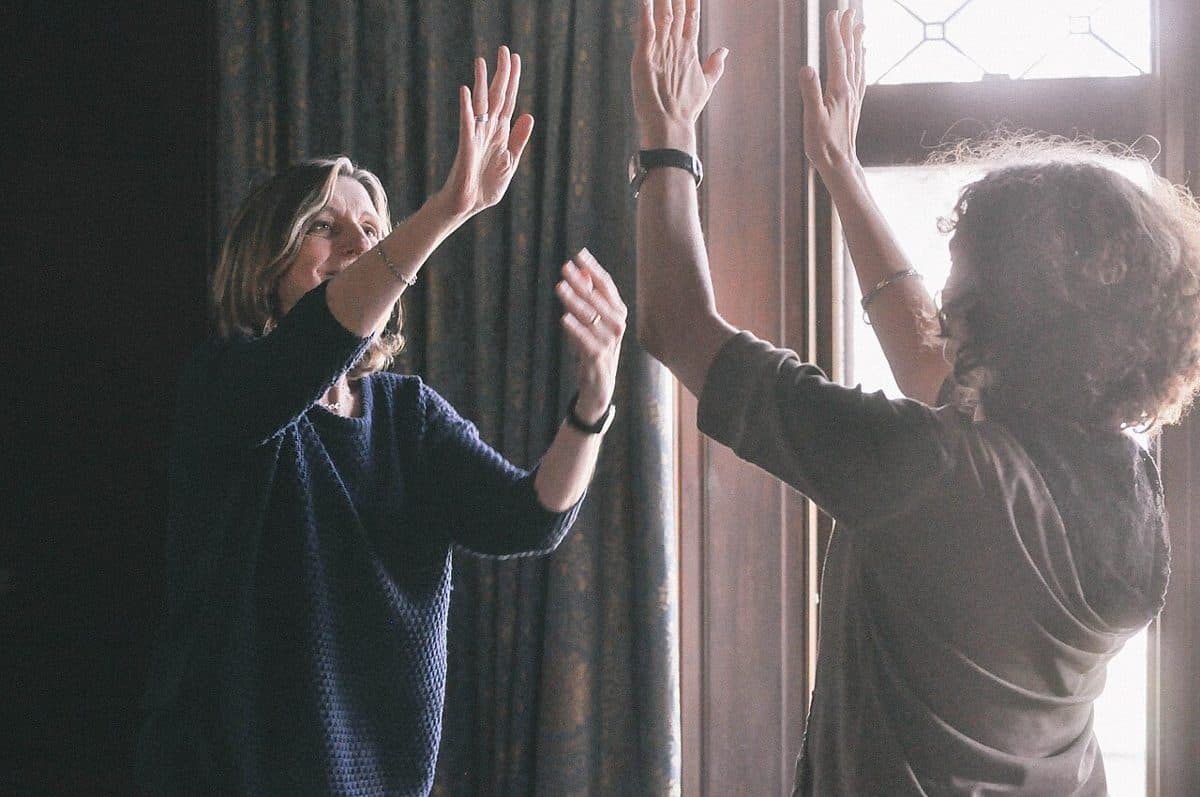
What does de-escalation mean?
De-escalation covers everything that takes back the sharpening of a conflict before it turns into violence or a complete break. It is not a single technique but a stance with several tools, chosen according to how far the conflict has already gone.
The basis for that is the stage model by Friedrich Glasl. He distinguishes nine stages, from the hardening of positions through the shift from the issue to the person to the willingness to accept harm to oneself if it also harms the other side.
The practical value of the model lies not in the counting but in the diagnosis. Knowing which stage a conflict is at also tells you what is still possible and what is not.
What helps to de-escalate a heated moment?
The first part is physical and has little to do with arguments: distance, a calm voice, slower speech, fewer onlookers, a seat. A tense situation lowers the capacity to take anything in, and sentences that are obvious when calm do not arrive.
The second part is listening with feedback. Reflect back what you understood, without agreeing and without contradicting. That separation is unfamiliar: understanding is not consent, but in the moment it calms much the same way.
The third part is choice. Someone who sees no room to act escalates, because nothing else is left. Two small, equally acceptable options give it back without anyone having to give in.
When is de-escalation called for?
Whenever the tension is higher than the question at issue. In schools, care homes, on public transport, at counters and in volunteering that is the normal case, not the exception.
It also fits as prevention, and there it works best. The early stages are the ones where a conversation is still about the matter. Intervening there takes little; waiting means needing a procedure or a court.
It does not fit as a substitute for protection. Where violence is threatened or already happening, safety comes before conversation technique, and the right decision may be to leave the room and get help.
Where are the limits of de-escalation?
De-escalation resolves no conflict. It only restores the conditions under which one can be worked on. Whoever does not then settle the matter will see the same flare-up again, and sooner next time.
At the later stages of the escalation model, conversational means no longer suffice. There it takes a third person with a procedure, a decision, and in severe cases a separation of the parties.
And it is not a question of talent. The techniques can be learned, and they reliably fail for anyone applying them under pressure for the first time. That is why they belong in the training for jobs with frequent public contact, not on a leaflet.
How do you start with de-escalation?
With the stage question. Before the next difficult situation, judge an existing conflict once: is it still about the matter, already about the person, or about harming the other side? That single classification changes the choice of means more than any technique.
Then a small everyday exercise: in the next conversation, once repeat back what the other person said before answering. Nothing more. It slows the conversation by exactly the amount that makes it manageable again.
For organisations with frequent flare-ups the first step is organisational: settle who steps in, where people can withdraw to and how the incident is reviewed. De-escalation is easier when it does not depend on how one person is feeling that day.
The core
De-escalation is not giving in. It lowers the temperature so the matter becomes negotiable again.
Sources
The steps
- Identify the stageFirst judge how far the conflict has gone. Is it still about the matter, already about the person, or about harming the other side? Each stage takes different means, and a means from the wrong stage makes things worse.
- Lower the tensionCreate distance, take down volume and pace, reduce the audience, offer a seat. These are not tricks but the precondition for anyone being able to listen at all.
- Listen and nameReflect back what you have heard, without agreeing or disagreeing. Someone who feels understood does not have to get louder to be understood. It is the most effective and the least used step.
- Open a choiceOffer a choice instead of an instruction. Two options, both acceptable, both small. Someone with no choice escalates; someone who can choose stays able to act.
- Settle it afterwardsThe matter itself is discussed later, not in the heated moment. De-escalation does not resolve the conflict; it restores the conditions under which it can be worked on.
More in this series
- Nonviolent CommunicationEveryday life, work, school, family, mediating between groupsFour steps that turn an accusation into a statement about your own situation. It sounds simple and is the hardest exercise in an argument
- Peer mediation in schoolsSchools, youth work, leisure facilitiesPupils mediate between their peers, by fixed rules and without a teacher at the table. It works better than it first sounds
Frequently asked questions about de-escalation
What stages of de-escalation are there?
A well-known model comes from the Institute for Professional De-escalation Management (ProDeMa). A script by the accident insurance fund of Baden-Württemberg names five stages that build on each other: preventing or reducing triggers of aggression, perceiving and correctly reading agitated behaviour, understanding its causes and motives, verbal de-escalation and finally safety advice and defence techniques in case of an attack. De-escalation thus starts long before the acute dispute, with the processes, rooms and waiting times that let anger arise in the first place.
How long does a verbal de-escalation take?
According to the ProDeMa script, a verbal de-escalation lasts from 20 seconds to two and a half minutes at most. It has five phases that build on each other, and if one of the first four fails, the whole fails. Then the only option left is to leave the situation. The first phase is making contact: if someone is shouting at you, do not join a loud duel but interrupt once, briefly and clearly, for example with the person’s name, and then lower your own voice straight away.
Does de-escalation resolve the conflict?
No, and that is not its job. De-escalation lowers the agitation and prevents a dispute from tipping into violence. The cause of the dispute remains. The ProDeMa script puts it plainly: only after a de-escalation do clarifying talks about practical solutions make sense. That is why a successful de-escalation is ideally followed by a second step, depending on the situation a conversation with I-messages, a peer mediation or a mediation in which the actual question is put on the table.
Why does de-escalation matter so much in care and hospitals?
Because staff there experience violence particularly often. According to the accident statistics of the German Social Accident Insurance, 6.9% of occupational accidents in health and social care in 2021 were caused by violence, more than in any other sector. The statutory accident insurer for health and welfare services therefore recommends de-escalation training and advises not to leave agitated people alone, to speak calmly in a low voice and to keep at least an arm’s length of distance. If it does not work alone, the attempt is stopped and help is called.
How can you help as a witness without putting yourself in danger?
The German police crime prevention programme sums it up in six rules: help, but do not put yourself in danger. Call the police on 110. Ask others to help. Memorise features of the offender. Look after victims. Give evidence as a witness. The idea behind it is to help without playing the hero. Addressing others directly, for instance “You in the red jacket, please call the police”, brings in support without stepping between the people who are fighting.
What should you avoid in a tense situation?
Above all, a contest of volume. The ProDeMa script describes moments in which two people talk loudly at the same time as especially prone to escalation. Provocation, threats and too little distance are just as risky. The BGW names at least an arm’s length as the limit. Arguments about the issue also help little at that moment, because a highly agitated person can hardly take them in. More helpful are attention, understanding for the problem and a concrete offer of what happens next.
From a procedure to a mission of your own
Every one of these methods was developed by people who had a dispute in front of them and wanted to handle it differently. The same stance is what it takes on a small scale: in a neighbourhood, a school, a club.
Find your peace mission