How wars ended
The Oslo Accords
Secret talks in Norway led to mutual recognition. What was deliberately left open decided how the rest would go
Key points at a glance
- The Oslo Accords are two agreements between Israel and the Palestine Liberation Organisation (PLO): the declaration of principles of 13 September 1993 and the interim agreement of 28 September 1995.
- They were prepared in secret talks in Norway. Four days before the first signature, each side recognised the other in an exchange of letters.
- The parties agreed on a five-year transitional period with Palestinian self-government. Jerusalem, refugees, settlements, security and borders were to be negotiated only afterwards.
- The final-status talks failed at Camp David in July 2000. The division of the West Bank into three zones from 1995 is still partly in place today.
In numbers
5
years of transition planned
the final status was to be negotiated afterwards
3
zones in the West Bank
A, B and C, set out in the 1995 agreement
0
final-status questions settled
Jerusalem, borders, refugees and settlements stayed out
Declaration of principles, Oslo I
- Signed
- 13 September 1993 in Washington
- Signatures
- Shimon Peres and Mahmoud Abbas, in the presence of Rabin and Arafat
- Subject
- Principles of self-government for a transitional period
- Core
- Five years of transition, final-status talks no later than the start of the third year
Interim agreement, Oslo II
- Signed
- 28 September 1995 in Washington, negotiated in Taba
- Signatures
- Yitzhak Rabin and Yasser Arafat
- Subject
- How those principles apply in the West Bank and the Gaza Strip
- Core
- Three zones with different responsibilities, Area C covering about 60 per cent of the land
Talks in Norway
From January 1993 envoys of both sides meet in Norway, at first without a formal mandate and away from the public.
Mutual recognition
On 9 September 1993 the PLO recognises Israel’s right to exist, and Israel recognises the PLO as the representative of the Palestinian people.
The declaration of principles
On 13 September 1993 the text is signed in Washington. It sets a transitional period and postpones the hardest questions.
Gaza and Jericho
With the Cairo agreement of 4 May 1994 Israel withdraws from most of the Gaza Strip and from Jericho.
The interim agreement
On 28 September 1995 Oslo II follows. The West Bank is divided into Areas A, B and C.
A summit without result
In July 2000 both sides negotiate the final status at Camp David. The summit ends without agreement.
- Period
- 1993 to 1995
- Place
- Oslo, Washington and Taba
- Parties
- Israel and the Palestine Liberation Organisation, mediated and hosted by Norway
- Outcome
- A declaration of principles of 13 September 1993 and an interim agreement of 28 September 1995, both meant for a transitional period
- Author
- Johannes Max Harms
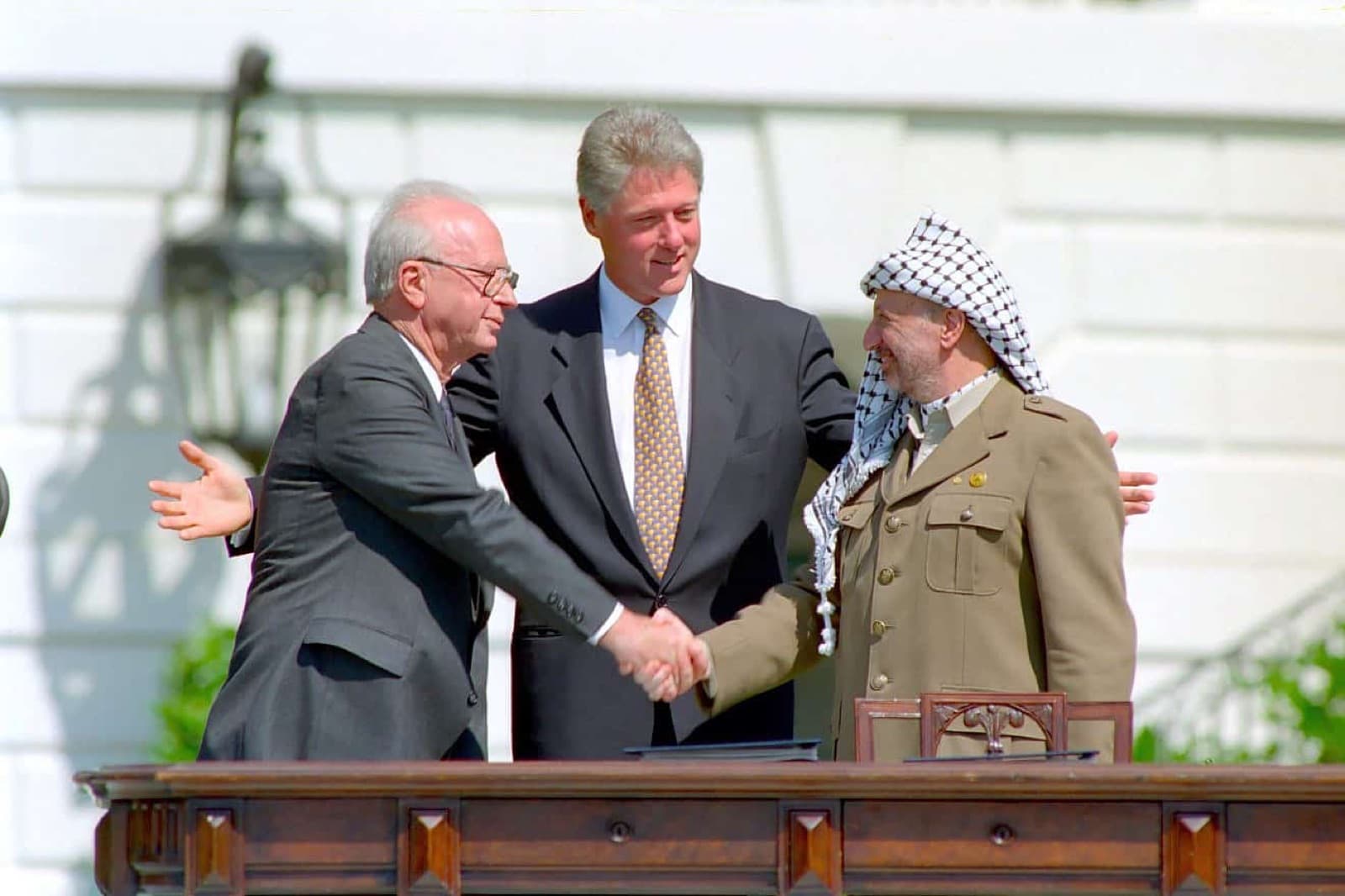
What were the Oslo Accords?
The Oslo Accords are two agreements between Israel and the Palestine Liberation Organisation. The first, a declaration of principles on interim self-government arrangements, was signed in Washington on 13 September 1993; the second, an interim agreement, on 28 September 1995.
They came about in an unusual way. From January 1993 representatives of both sides met in Norway for talks that were unofficial at first. Only once an understanding was in sight did the process become official.
The real breakthrough came before the signature. In the exchange of letters of 9 September 1993 each side recognised the other: the PLO the state of Israel and its right to exist, Israel the PLO as the representative of the Palestinian people. Without that mutual recognition no text would have been possible.
Who negotiated, and why in Norway?
Envoys of both sides did the negotiating. The declaration of principles was signed by Foreign Minister Shimon Peres and by Mahmoud Abbas for the PLO, in the presence of Prime Minister Yitzhak Rabin and PLO chairman Yasser Arafat. The 1995 interim agreement carries the signatures of Rabin and Arafat. Norway provided the venue, the mediation and the discretion.
Retreating to a small, uninvolved country had a practical reason: official talks would have failed on domestic resistance on both sides before there was a result. An unofficial channel lets an understanding be tested first and defended afterwards.
The same feature is also the weakness of the method. What is made in secret is finished when it is published, but not carried. Both societies learned of the result without having been part of the way there.
What was agreed?
The parties agreed on a five-year transitional period with a Palestinian self-government that was to take on responsibilities step by step. The period was to begin with the withdrawal from the Gaza Strip and the Jericho area, which the Cairo agreement settled in May 1994. An elected council was to carry the self-government.
The 1995 interim agreement divided the West Bank into three zones: Area A under Palestinian administration and security, Area B with Palestinian administration and Israeli security responsibility, Area C under Israeli control. According to Germany’s Federal Agency for Civic Education, Area C covers about 60 per cent of the territory. The division was meant as an intermediate step.
The questions at the heart of the conflict stayed out. Article V of the declaration of principles lists them: Jerusalem, refugees, settlements, security arrangements, borders and relations with the neighbours. They were to be negotiated no later than the start of the third year of the transitional period. Leaving them out was no oversight; it was the condition for anyone signing at all.
How long did the arrangement hold?
The transitional period was due to end in 1999. Talks on the final status took place, last at the Camp David summit in July 2000, but led to no conclusion. The order of 1995, meant to be provisional, is still partly in place today.
In between came events that weakened the process: the assassination of Rabin in November 1995, attacks and armed clashes, the expansion of settlements. Which cause weighs how much remains a matter of lasting dispute, and this series does not settle it.
The structural finding is not in dispute. An agreement that refers its hardest questions to a later procedure depends on that procedure taking place. If it does not, the interim solution remains as a permanent state it was not built for.
What can be learned from it?
The first finding is positive and often overlooked: the mutual recognition of 1993 was a step nobody had thought possible before. That two sides accept each other as counterparts is the precondition of any negotiation and a result in its own right.
The second finding concerns the design. Camp David had shown in 1978 what a concrete text achieves: a territory, a deadline, two signatures. Oslo pushed the concrete part back. The series shows both ways in the same conflict, with different outcomes.
For any mediation this raises a sober question: what happens if the second step does not come? An agreement should still be workable if its follow-up never arrives. Without that safeguard, the interim step becomes the result without meaning to be.
Which agreements followed Oslo II?
The 1995 interim agreement was not the last text. In January 1997 the Hebron Protocol settled the partial withdrawal from the city of Hebron. In October 1998 the Wye River Memorandum provided for further Israeli withdrawals from the West Bank, and in September 1999 the Sharm el-Sheikh Memorandum committed both sides to start final-status negotiations.
Each of these texts carried out part of what had already been agreed in 1993 and 1995, or set new deadlines for it. The pattern stayed the same: steps of the transitional period were negotiated, renegotiated and stretched, while the final-status questions remained open.
In July 2000 a summit at Camp David took up exactly those questions. According to the Office of the Historian of the US Department of State, it ended without agreement on the West Bank and the Gaza Strip. At the end of September 2000 the Second Intifada began, and with it ended the phase in which the interim order was still negotiated as a path to an overall settlement.
What follows from it
An interim solution without a binding end point becomes a permanent state. Postponing the hard part creates movement and pushes the risk further back.
Sources
- German Federal Agency for Civic Education (bpb): the Oslo Accords as milestones in the Middle East peace process (in German)
- German Federal Agency for Civic Education (bpb): 30 years ago, Rabin and Arafat sign Oslo II (in German)
- Office of the Historian, US Department of State: The Oslo Accords and the Arab-Israeli Peace Process
- Avalon Project at Yale Law School: Declaration of Principles on Interim Self-Government Arrangements, 13 September 1993
- Nobel Foundation: The Nobel Peace Prize 1994
How it unfolded
- January 1993Unofficial talks between Israeli and Palestinian representatives begin in Norway, at first without any formal mandate.
- 9 September 1993In an exchange of letters each side recognises the other: the PLO the state of Israel, Israel the PLO as representative of the Palestinian people.
- 13 September 1993The declaration of principles is signed in Washington. It settles a transitional period and moves the hardest questions to the end.
- 4 May 1994The Cairo agreement carries out the first step. In July the Palestinian self-government under Arafat takes up its work.
- December 1994Arafat, Peres and Rabin receive the Nobel Peace Prize. At that moment the process is treated as a model for other conflicts.
- 28 September 1995The interim agreement divides the West Bank into three zones with different responsibilities for administration and security.
- 4 November 1995Yitzhak Rabin is shot dead in Tel Aviv. The process loses one of its two signatories.
- July to September 2000The Camp David summit ends without agreement on the final status. At the end of September the Second Intifada begins.
More in this series
- The Camp David AccordsSeptember 1978 to March 1979Thirteen days without an audience, a mediator who would not let the parties leave, and at the end the first peace between Israel and an Arab state
- The Minsk AgreementsSeptember 2014 to February 2022Two agreements, thirteen points, seven years of talks. In the end the dispute was not about the text but about the order of its steps
Frequently asked questions
Why are the accords named after Oslo?
Because they were prepared in Norway. The secret talks that produced the declaration of principles took place in 1993 with Norwegian mediation. Both agreements were signed in Washington, the second after negotiations in Taba, Egypt.
What is the difference between Oslo I and Oslo II?
Oslo I is the declaration of principles of 1993. It sets out what is to apply during the transitional period and which questions are to be negotiated later. Oslo II is the interim agreement of 1995. It applies those principles to the West Bank and the Gaza Strip, among other things with the division into Areas A, B and C.
What do Areas A, B and C mean?
In Area A both administration and security lie with the Palestinian side; in Area B administration lies with the Palestinian side and security with Israel. Area C is under Israeli control and covers about 60 per cent of the West Bank. The division comes from the 1995 interim agreement and was meant as an intermediate step.
Who received the Nobel Peace Prize in 1994?
Yasser Arafat, Shimon Peres and Yitzhak Rabin shared the 1994 Nobel Peace Prize. The Nobel Committee honoured their efforts to create peace in the Middle East. The award fell between the two agreements, less than a year before Rabin was assassinated.
Which questions did the Oslo Accords leave open?
All those at the core of the conflict. The declaration of principles names them explicitly as subjects for later negotiation: Jerusalem, refugees, settlements, security arrangements, borders, and relations and cooperation with the neighbours. No agreement on them has been reached to this day.
From history to a mission of your own
Every one of these treaties was the work of people who thought it could be done. The same stance is what it takes on a small scale: in a neighbourhood, a school, a club.
Find your peace mission